graph LR
    AND["**Andromeda**<br/>Aquilaria · Avaros<br/>Skopalia · Elyros"]
    TRI["**Triangulum**<br/>Skopalia · Elyros · Enthor"]
    MW["**Milky Way**<br/>Avaros · Terran Compact<br/>Wrulis outposts"]
    LMC["**Large Magellanic Cloud**<br/>Wrulis · Enthor"]
    SMC["**Small Magellanic Cloud**<br/>Enthor · Omalian<br/>Elyros · Wrulis"]

    AND -- "Aquilaria / Avaros" --- MW
    AND -- "Aquilaria / Skopalia / Elyros" --- TRI
    TRI -- "Skopalia / Avaros" --- MW
    MW -- "Avaros / Wrulis" --- LMC
    LMC -. "destroyed · SY 5.151.264<br/>3 yrs dark · rebuild blocked<br/>by competing claims" .- SMC
The Five Galaxies
Introduction
This document describes a universe, not how to live in it.
In the Sidereal Year 5.151.267 — equivalent to 7,396 CE by the human calendar — six major species inhabit the Local Group of galaxies: the Lynem, Che-esune, Tesu, Wrulisu, Omale, and Hetsu. Humans exist here too, scattered and adaptable, but not dominant. The Terran Compact governs a fraction of Orion’s Arm in the Milky Way. Outside that margin, human colonies are independent stations, struggling outposts, or communities absorbed into larger polities.
The Five Galaxies — Andromeda, the Milky Way, Triangulum, the Large Magellanic Cloud, the Small Magellanic Cloud — are connected by the Wormhole Access Network: bidirectional artificial wormholes whose access points are military, commercial, and industrial stations. Access to those stations can be denied — they are choke points, and the powers that hold them set the terms. Ships also traverse oddspace — a medium that enables faster-than-light travel but consumes fuel and tolerates no margin for error. A vessel that misjudges its route ends its journey somewhere it cannot refuel, and no rescue is coming.
Core worlds of major empires manufacture and deploy capabilities that frontier stations cannot maintain or replace. Exporting advanced technology is profitable; it is also a political act that disrupts the economies it enters and destabilizes the polities that receive it. The largest empires are cosmopolitan by necessity — too many species under one administration to enforce homogeneity — while smaller nations treat outsiders with suspicion that hardens to hostility at their borders.
Extinct civilizations left ruins in four galaxies. Their technologies remain functional. Their original purposes are unknown. Governments and private interests pay for survey data on new systems and recovered artifacts; both parties want exclusive rights to what they find.
Stories range from a succession crisis that could redraw the borders of two galaxies to a debt that needs clearing on a station nobody maps. The people in those stories are operators, brokers, surveyors, diplomats, smugglers, and soldiers — not heroes by default.
The situations this setting generates are already in motion.
The Charted Space
What Charted Space Is
Charted Space is not a geographic boundary — it is a set of agreements. A system is “charted” when it has been surveyed, registered with at least one recognized polity, and connected to the infrastructure of regular transit. In practice: someone mapped it, claimed it or logged it, and a route exists that can be serviced.
That registration carries legal weight. Vessels operating on registered routes are subject to inspection by the powers that maintain them. Cargoes are taxable. Disputes have theoretically recognized jurisdictions. Charted Space is where law exists — unevenly applied, frequently corrupt, and entirely absent in some registered systems, but present as a framework that shapes every transaction and border crossing.
Most settled populations in the Five Galaxies live within Charted Space. Most of the trade, communication, and political activity that governs them happens here. The infrastructure is real, the routes are maintained, and the cost of using them is built into the price of everything.
Beyond the Edge
Systems outside Charted Space fall into distinct categories. Travelers who work in them treat the distinctions as practical, not administrative.
Unmapped systems are unknown or incompletely surveyed. They may contain resources, habitable planets, or pre-collapse ruins. They may also contain hazards no chart documents: gravitational anomalies, hostile biology, equipment from extinct civilizations whose function has not been determined.
Dead zones are regions where no WAN node exists and oddspace navigation is unreliable or actively dangerous. Some are the result of natural phenomena; others are destroyed infrastructure. The difference matters — natural dead zones stay where they are.
Contested regions carry overlapping claims and no recognized jurisdiction. The typical consequence for travelers is that multiple parties may demand inspection, transit fees, or cooperation, sometimes simultaneously and with contradictory requirements.
Quarantine areas are officially designated exclusion zones. The stated reasons are usually biological hazard or unstable pre-collapse technology. The actual reasons are sometimes the same. Some quarantine designations are decades old; the authorities who issued them no longer exist, and enforcement has passed to whoever claims the adjacent space.
The Wormhole Access Network
The WAN is the primary infrastructure of inter-galaxy travel. It consists of artificial, bidirectional wormholes whose endpoints are maintained stations — military, commercial, or industrial facilities operated by one of the major powers or, in the case of contested nodes, by a coalition whose internal agreements are not always published. The WAN is not neutral infrastructure: every node is owned, every node has an operator, and access can be refused.
Natural wormholes exist but are rare, typically unidirectional, and emerge from gravitational phenomena rather than construction. They cannot be scheduled, are not maintained, and cannot be relied upon for regular transit. Some natural wormholes are mapped; some have no recorded exit point and are noted on charts as navigation hazards.
Artificial wormholes require ongoing maintenance. A node that is not serviced will degrade and eventually collapse. Several WAN corridors in contested or underfunded regions are known to be in poor repair. Transiting through a degraded node is not publicly advertised as dangerous — but the failure mode, if a node collapses mid-transit, has no confirmed survivors. The maintenance records for nodes in border regions are not publicly accessible.
The major powers maintain separate route networks that partially overlap. Aquilarian routes concentrate in Andromeda with extensions to Triangulum and the Milky Way. Avaros routes center on the Milky Way and reach into Triangulum and the Large Magellanic Cloud. Skopalian infrastructure focuses in Triangulum. The Empire of Wrulis operates primarily in the Large Magellanic Cloud with Milky Way extensions. The Commonwealth of Elyros links Triangulum and the Small Magellanic Cloud, with a growing Andromeda presence. The Confederacy of Enthor maintains minimal routes in the Small Magellanic Cloud, prioritizing resource exchange over connectivity. The points where these networks intersect are among the most contested locations in the Five Galaxies — every such junction is a chokepoint that someone controls and someone else wants.
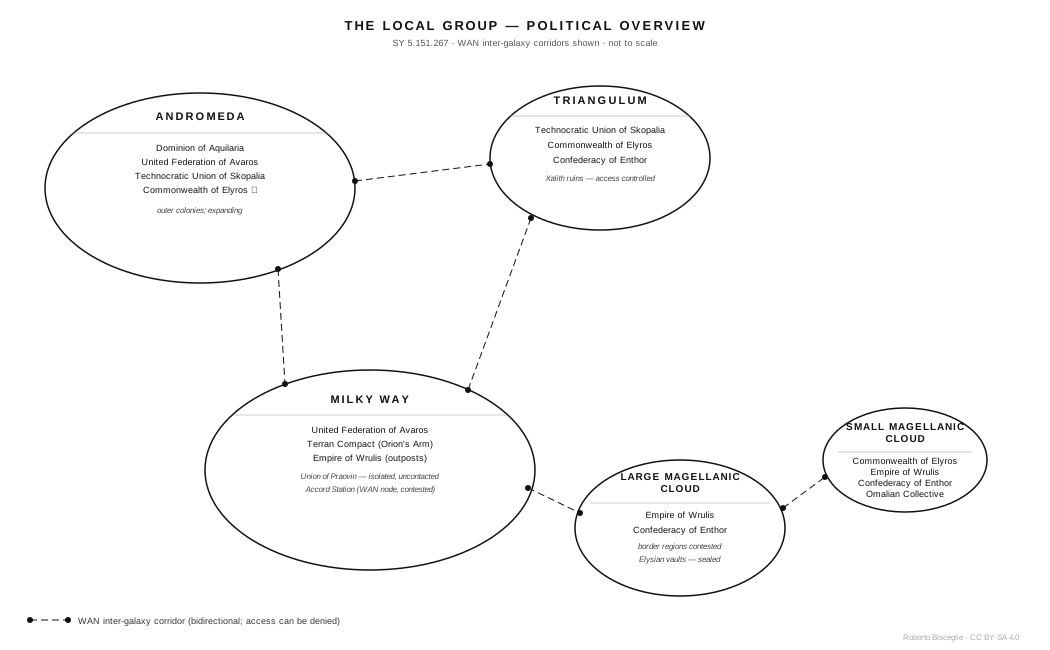
WAN Network Topology
Four active inter-galaxy corridors. One dark for three years. Each corridor is operated by whichever powers control the nodes at both ends — and any of them can deny access. The destroyed LMC–SMC link has three competing rebuild claims and no construction started.
Oddspace
Oddspace is the FTL medium ships traverse when not transiting through WAN wormholes. It is not a shortcut — it is a separate dimension of space entered and exited by drives that consume fuel. Within oddspace, conventional distances do not apply, but traversal still takes time, requires navigation, and requires fuel for the return to normal space.
The constraints are practical: fuel tanks have finite capacity, and oddspace offers no resupply. Route planning means identifying a chain of waypoints — ideally systems with functional fuel infrastructure — and not extending beyond what the ship’s tanks support. A ship that runs out of fuel in oddspace cannot call for help. Communications from within oddspace do not transmit to normal space.
Ships that enter oddspace without adequate charting data, or that encounter navigational anomalies mid-transit, may exit in unintended locations. “Unintended” can mean an unsurveyed system with no infrastructure. It can also mean a location that no chart records at all. Some of these have been found after the fact, by ships following distress beacons whose signal arrived months late. Some have not been found.
Oddspace and WAN travel are distinct and complementary. WAN corridors offer faster, more reliable transit between nodes but require access to maintained infrastructure and the approval of the operating power. Oddspace travel is slower and more demanding but does not require permission. The practical consequence is that WAN-controlling polities can deny transit rights to specific vessels — and those vessels can use oddspace to bypass the WAN, at higher fuel cost and navigational risk. This asymmetry is why embargoes are never fully enforceable and why some operators prefer not to appear in WAN transit logs at all.
Travel as a Pressure System
Movement within Charted Space is not free. Every standard route has a maintaining power that charges transit fees, conducts inspections, and reserves the right to refuse passage. Permits for certain cargo categories — advanced technology, weapons, biological materials, pre-collapse artifacts — may require approval from multiple jurisdictions when a route crosses polity borders, and the approvals do not always arrive before departure windows close.
Security on established routes is not uniform. Corridors between major core systems are patrolled; piracy on them carries a measurable response risk. Routes at the edges of polity territory, through contested regions, or through underfunded corridors receive less attention. Escort services exist for freight that cannot risk unprotected transit; their cost is high enough that operators who decline are making a deliberate calculation.
Embargoes and political closures occur without advance notice. A trade dispute between two powers can result in a WAN node being declared closed to vessels registered with the opposing power within hours of a diplomatic breakdown. Vessels caught mid-route face diversion, inspection, or impoundment depending on which node they reach first. There is no general early-warning system for closures; the closest equivalent is a network of brokers and station operators who sell transit intelligence as a service.
The most consistent feature of travel in the Five Galaxies is that the cost, risk, and availability of transit are set by whoever controls the infrastructure between origin and destination — and that control is always conditional, always contested, and always worth money to the right buyer.
Chronological Reference
The dates below are anchor points in the Sidereal Year (SY) calendar, a common standard used by convention across most of Charted Space. Earlier records are fragmentary, internally inconsistent, or held exclusively by specific powers who have not published them. The events listed here represent what is broadly known — or broadly believed — not what is fully documented.
Current date: SY 5.151.267 (= 7,396 CE by the human solar calendar).
SY undatable — Collapse of the Precursor civilization (Milky Way, Orion’s Arm). Physical dating places the youngest confirmed sites at approximately 48,000–50,000 SY before current; the oldest documented site exceeds 10 million SY before current. Ruins are distributed across a limited number of Orion’s Arm systems. Partially translated Precursor records describe the collapse as a rimward catastrophe; the nature and origin of that catastrophe have not been confirmed. Several of the most intact sites fall within Rim Concord restricted zones whose rationale the Zynthari have not disclosed.
SY ~5.101.000 — Collapse of the Celestial Dominion (Andromeda Galaxy). The last of their orbital megastructures was abandoned within a few centuries of this date. The collapse mechanism is unknown; Lynem historical records, the oldest surviving sources, disagree on the date by approximately 20,000 SY.
SY ~5.116.000 — Cessation of the Xalith Empire (Triangulum Galaxy). The last confirmed Xalith-built structure continues to transmit on a frequency no current species has decoded. What ended the Xalith is not recorded in any source accessible to researchers.
SY ~5.128.000 — The Elysian Empire ceases all external contact (Large Magellanic Cloud). No military defeat is recorded; available evidence suggests a voluntary withdrawal followed by silence. Their genetic vaults were sealed from the inside.
SY ~5.135.000 — Foundation of the Dominion of Aquilaria (Andromeda). The oldest reliably dated polity in the Five Galaxies by external record. Lynem dynastic histories extend the lineage significantly further back; those extensions are not independently verified.
SY ~5.143.000 — Foundation of the Empire of Wrulis (Large Magellanic Cloud). Imperial records trace the current dynasty to this date. Infrastructure dating conducted by external researchers places the actual consolidation of territorial control approximately 600 SY later; the Empire contests this finding.
SY ~5.148.000 — First reliable documentation of natural wormhole transit (Triangulum–Milky Way corridor). Multiple species claim independent prior discovery. The credit dispute has not been resolved and resurfaces in treaty negotiations at irregular intervals.
SY 5.150.033 — First artificial wormhole constructed and stabilized. The Technocratic Union of Skopalia claims full priority. The United Federation of Avaros holds documents indicating a collaborative research program whose Skopalian partners dissolved the partnership and retained the technology unilaterally. Neither party has agreed to arbitration.
SY 5.150.412 — First inter-galaxy WAN corridor established (Triangulum to Milky Way). The original operating protocols granted equal access to all registered vessels; those protocols were amended eleven times in the first century of operation.
SY 5.150.619 — United Federation of Avaros formally chartered. Founded to provide Milky Way governance that did not require species dominance. The specific conflict the founding was intended to resolve is not named in the founding documents.
SY 5.150.891 — Confederacy of Enthor ratified (Small Magellanic Cloud). The treaty followed Hetsu-Tesu skirmishes over resource systems in the Large Magellanic Cloud border regions. Neither the Empire of Wrulis nor the Confederacy describes the outcome of those skirmishes in compatible terms.
SY 5.151.104 — Last confirmed transmission from Survey Expedition SY-7 (Xalith Rift, Triangulum). The Technocratic Union of Skopalia classified the expedition’s prior transmissions. No search expedition has been authorized. The Rift access coordinates used by SY-7 are not publicly available.
SY 5.151.267 — Current date.
The Five Galaxies
The Local Group spans approximately three million light-years. Five galaxies within it are connected by the Wormhole Access Network and support interstellar civilizations. Each is politically and environmentally distinct. Each is described here at the level of powers, pressures, and available stories — not as a comprehensive survey. The tensions listed are active. The locations named are notable examples, not complete records.
Andromeda
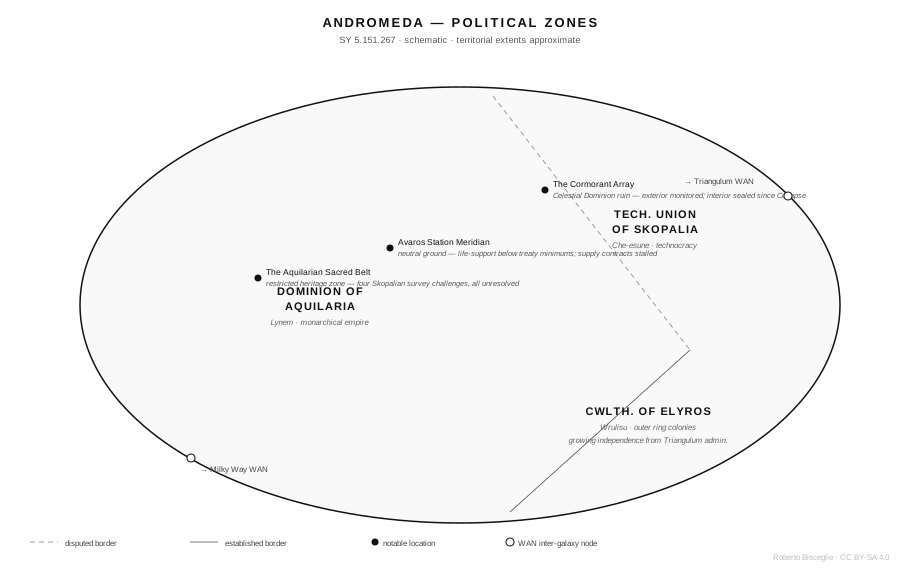
Andromeda is where old empires manage ancient rivalries while arguing over ruins that neither of them can open.
Political climate. Four major powers have occupied Andromeda long enough that their territorial boundaries look permanent on maps and function as flashpoints in practice. The Dominion of Aquilaria and the United Federation of Avaros have maintained an adversarial equilibrium for centuries — Aquilaria expanding through military pressure, Avaros resisting through diplomatic frameworks that Aquilaria ignores when convenient. The Technocratic Union of Skopalia and the Commonwealth of Elyros share a nominally cooperative relationship that fractures whenever a pre-collapse Celestial Dominion site becomes accessible. Aquilaria controls the approaches to the most intact Celestial Dominion megastructures and has used that control to block Skopalian survey requests for the past forty years without formally rejecting them.
Major powers.
Dominion of Aquilaria | Lynem | Monarchical empire, hereditary rule, council of noble houses, feudal regional governors | Core objective: expand territorial control and preserve Lynem cultural primacy in Andromeda | Internal fault line: noble houses compete with military commanders for policy influence; the current monarch’s health is not publicly disclosed | Right now: securing physical access to Celestial Dominion megastructure sites before Skopalian survey teams can document their contents
United Federation of Avaros | Multispecies | Representative democracy, rotating species leadership, Council of Representatives | Core objective: sustain a multispecies governance framework that prevents any one species from holding permanent dominance | Internal fault line: rotating leadership creates policy reversals every generation; the current Avaros council has been deadlocked over Aquilaria relations for six years | Right now: a negotiated settlement with Aquilaria that does not require military expenditure Avaros cannot sustain
Technocratic Union of Skopalia | Che-esune | Technocratic republic, leadership by demonstrated scientific expertise, Bureau of Resource Allocation | Core objective: maintain technological advantage through control of pre-collapse research and strategic mineral access | Internal fault line: an entrenched senior research tier blocks outside access and younger Skopalian scientists are leaving for Avaros institutions | Right now: exclusive survey rights to Celestial Dominion ruins in the Andromeda outer belt before Aquilaria’s blockade becomes permanent policy
Commonwealth of Elyros | Wrulisu | Cooperative colony governance, individual colony autonomy with central representation | Core objective: preserve colony autonomy and inter-colony resource sharing | Internal fault line: Andromeda colonies have been operating with increasing independence from the Triangulum-based central administration; several have begun bilateral negotiations with Aquilaria | Right now: territorial recognition from Aquilaria for the Andromeda outer colonies, which Aquilaria has declined to formalize
Economic pressure. The asteroid belts adjacent to Celestial Dominion megastructure sites contain rare minerals essential for advanced manufacturing. Access to those belts is controlled by Aquilarian transit permits that can be revoked without cause. Medicinal biotech compounds from Andromeda’s surviving ecospheres are commercially valuable; Aquilaria controls most of the surveyed extraction sites and sets export prices unilaterally. Skopalia’s graviton crystal deposits in Andromeda give it leverage it would lose if Aquilaria’s territorial consolidation continues.
Typical conflicts. Aquilarian border patrols intercepting Skopalian survey ships near ruins sites and confiscating equipment under “preservation protocols” that have no treaty basis. Avaros diplomatic missions stalled for months by Aquilarian administrative review procedures that do not formally exist. Elyros colony supply convoys rerouted through Aquilarian checkpoints where inspection fees are not standardized. A secondary market in Celestial Dominion artifacts operates through Avaros-registered intermediaries; the artifacts’ provenance is uniformly undocumented.
Story register. Andromeda supports stories from the macro-political — a breakdown in the Aquilaria-Avaros equilibrium that would redraw access to every WAN node in the galaxy — down to the operational: a survey team with permits for one Celestial Dominion site and evidence that something far more valuable is in the adjacent restricted zone. The Elyros colonial drift is a slow-motion succession of small decisions that could end in a permanent split or an Aquilarian annexation, and neither outcome is certain yet.
The Aquilarian Royal Navy has placed an exclusion perimeter around a Celestial Dominion megastructure in the outer belt — officially for “structural preservation.” Skopalia wants access to document it. Avaros wants to broker access rights. A salvage crew that entered three months ago has not returned, and their last transmission was jammed before anyone could confirm its contents.
An Elyros colony in Andromeda’s outer ring has ceased reporting to the Commonwealth administration and has been negotiating a bilateral trade agreement with Aquilaria. The Commonwealth wants to know why. Aquilaria’s response to any inquiry is that the colony’s business is its own.
Notable locations. This list is not a survey of Andromeda — it identifies three locations relevant to current tensions.
- The Cormorant Array — a Celestial Dominion orbital megastructure in the Aquilaria-Skopalia border region, partially functional, with internal sections that have not been accessed since the Dominion’s collapse. Both powers have installed monitoring equipment on the exterior. Neither has successfully entered.
- Avaros Station Meridian — the Federation’s primary diplomatic facility in Andromeda, designated neutral ground by treaty. Aquilaria has been delaying its maintenance supply contracts for three years. The station’s life-support redundancy is now below treaty-mandated minimums.
- The Aquilarian Sacred Belt — an asteroid field formally designated a Lynem cultural heritage site. External surveys and transit are prohibited. Skopalia maintains the designation was issued specifically to prevent mineral surveying and has filed four treaty challenges, all unresolved.
Milky Way
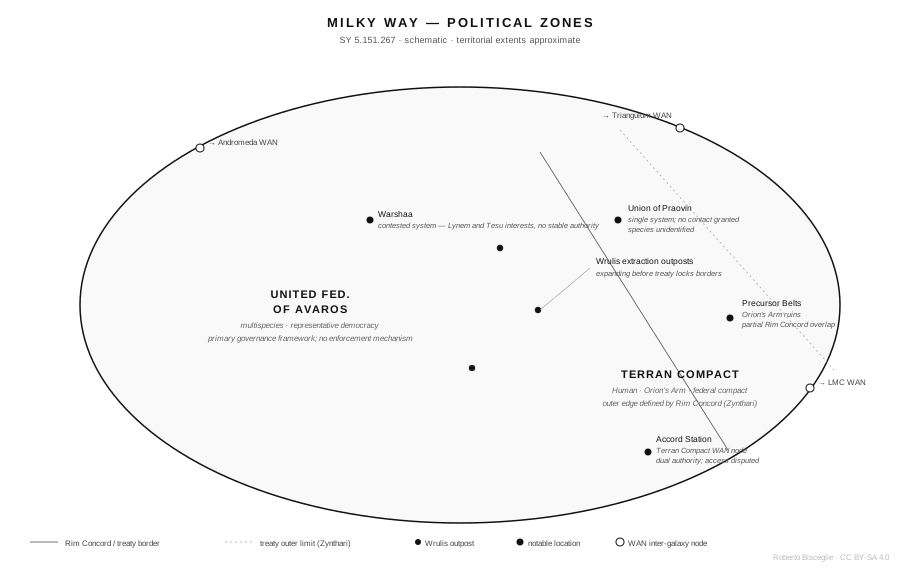
The Milky Way is where the Lynem and Tesu have been contesting dominance for longer than most polities have kept records, and where a third party controls a system no one has successfully described.
Political climate. No single power controls a majority of the Milky Way. The United Federation of Avaros functions as the primary governance framework for the multispecies population, but its authority depends on continued trade and has no enforcement mechanism against a determined unilateral actor. Lynem colonial interests extend from Andromeda; Tesu interests extend from the Large Magellanic Cloud. Neither can commit fully here while managing obligations elsewhere. The Terran Compact holds Orion’s Arm territory built through centuries of independent expansion and operates its own FTL infrastructure; its outer edge is defined by the Rim Concord with the Zynthari — a constraint the Compact did not choose and has not been able to revise. The Union of Praovin controls a single system and has declined every formal diplomatic contact from any registered power.
Major powers.
United Federation of Avaros | Multispecies | Representative democracy | Core objective: maintain the Milky Way as a non-dominance multispecies space | Internal fault line: member species disagree on trade priority; the current Council has been unable to ratify a new transit-fee structure for four years | Right now: a treaty revision with both Aquilaria and the Empire of Wrulis that prevents either from using Milky Way territorial gaps to expand unchecked
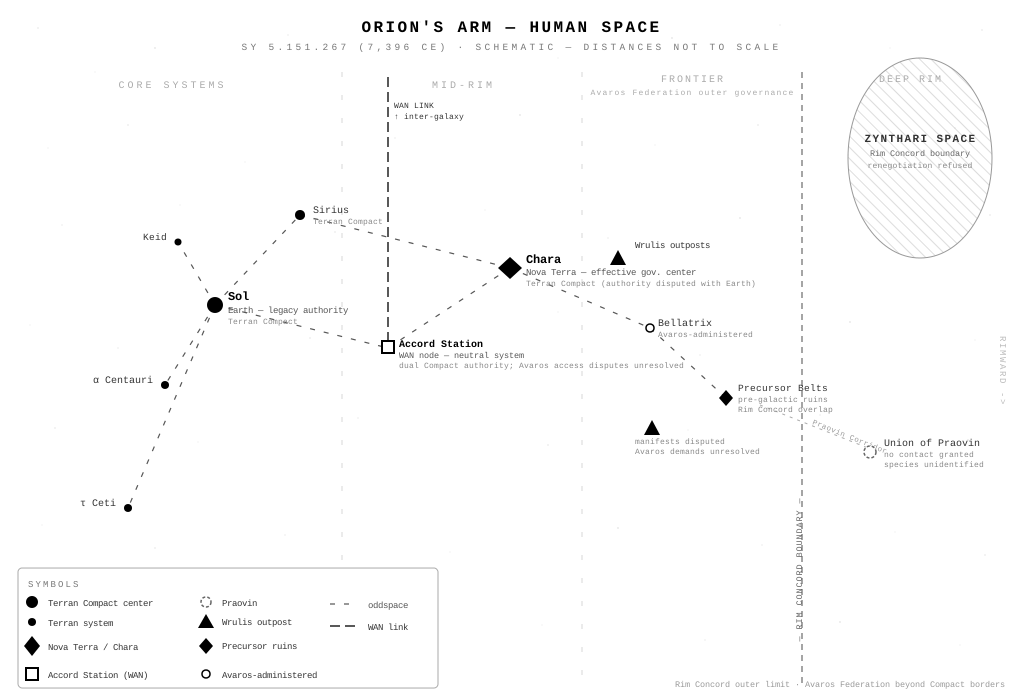
Terran Compact | Human | Federal compact; de facto administration at Nova Terra (Chara system), formal institutional authority at Earth, the discrepancy unresolved | Core objective: maintain Orion’s Arm territorial integrity and manage the Rim Concord constraints that define the Compact’s outer edge | Internal fault line: Nova Terra’s governing bloc and Earth’s legacy institutions hold incompatible claims to Compact authority; the ambiguity is the working arrangement, not a gap either side is trying to close, because resolution would require one to formally subordinate the other | Right now: a frontier coalition demanding Rim Concord renegotiation with the Zynthari, which the Nova Terra administration refuses to table — any revision requires Zynthari engagement and the Zynthari have given no signal they are willing to open the Concord
Empire of Wrulis (Milky Way outposts) | Tesu | Imperial authority extended from LMC primary territory | Core objective: resource extraction and strategic positioning in advance of treaty negotiations | Internal fault line: outpost commanders operate with limited oversight from LMC imperial authority, making their decisions difficult to formally disavow | Right now: expanding extraction operations in Avaros-adjacent systems before a new treaty locks current borders
Union of Praovin | Unknown | Unknown | The Praovin system is charted; the Union is registered in WAN records as a recognized polity. No diplomatic mission to the system has been granted entry. No census, survey, or biological record is publicly available. The species inhabiting the system has not been formally identified. Transit through the Praovin Corridor is intermittently blocked without notice or explanation.
Economic pressure. The Milky Way contains the highest density of habitable planets of any galaxy in the Local Group, which drives colonization competition that no treaty has resolved. Duranium and stellium alloy deposits in contested border systems are extracted by whichever party is currently able to operate there; the legal status of that extraction is contested in every case. Pre-collapse ruins scattered across the galaxy contain technological fragments that Skopalian and Wrulis survey teams both want; Avaros policy requires survey data sharing, which both parties circumvent routinely.
Typical conflicts. Species customs disputes at Avaros trade hubs, where what counts as a controlled substance varies by species and by who is conducting the inspection. Wrulis extraction teams filing paperwork with Avaros-registered WAN nodes while operating in systems their permits do not cover. Human colony stations used as informal resupply points by both Lynem-aligned and Tesu-aligned vessels, sometimes simultaneously, without the colonies being consulted. The Praovin Corridor blocked again, no explanation given, and a cargo convoy that was three days out now needs a reroute that adds six weeks.
Story register. The Milky Way’s scale means that any story from species-level negotiation to a single cargo dispute can coexist here. Human characters are local players navigating between forces that are not particularly interested in them. The Praovin situation is a gap in the record that is either dangerous or profitable depending on what fills it.
The Union of Praovin has submitted a request for licensed surveyors through an Avaros diplomatic channel. The request does not state the survey target, the compensation terms, or what credentials are required. Avaros forwarded it without comment. Three parties have responded, and none of them are survey firms.
A Wrulis extraction outpost in a nominally Avaros-registered system has been operating for four years. The Federation’s repeated withdrawal demands have produced no response. The outpost’s cargo manifests — filed with a WAN node it uses — show materials that do not match anything that system was surveyed to contain. The manifests are public record. No one has acted on them.
Notable locations. This list is not a survey of the Milky Way.
- Warshaa — a multi-planet system with no stable governing authority; Lynem colonial interests and Tesu commercial operations have each held administrative control here at different times, and the current situation is that both are present and neither is officially recognized.
- Accord Station — the Terran Compact’s sole WAN interface, placed in a neutral Orion’s Arm system through four years of political dispute between Earth’s legacy institutions and Nova Terra’s governing bloc; neither party got the location it wanted, and both administer the station under incompatible authority. Access disputes with Avaros persist because two Compact bodies apply contradictory standards to non-human traffic through the same node.
- The Praovin Corridor — the only charted approach to the Union of Praovin’s home system; traffic is intermittently closed without notice, and no vessel that has passed through under Union authorization has subsequently reported on what it found.
- The Precursor Belts — Orion’s Arm systems containing ruins of a local extinct civilization distinct from the Celestial Dominion, Xalith, and Elysian; the oldest sites predate reliable galactic records by a margin instrumentation cannot resolve. Partial translation of Precursor records is ongoing in Terran Compact research institutions. Several of the most intact sites fall within Rim Concord restricted zones, which the Zynthari have designated under ancient claims without specifying their nature.
Triangulum
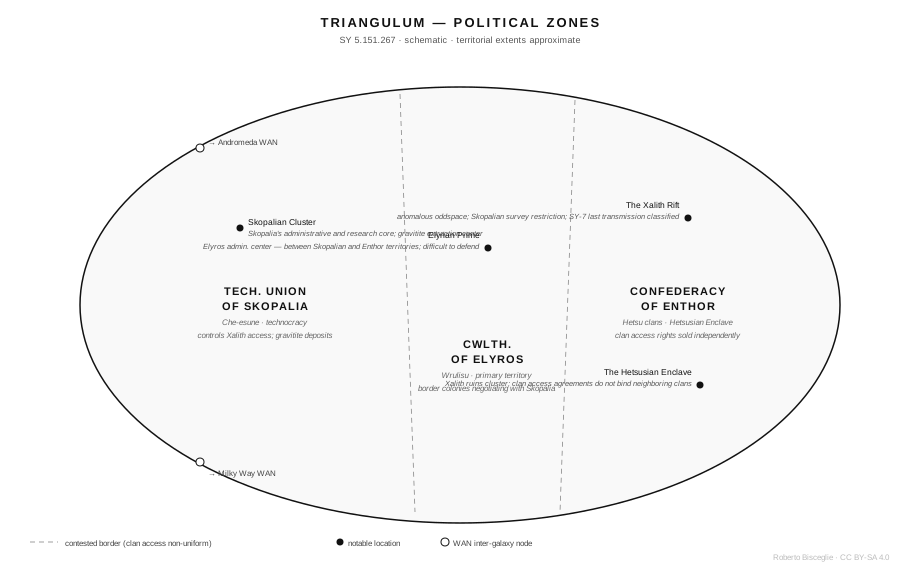
Triangulum is where two powers have been fighting over ruins they cannot read for two centuries, while a third controls the only reliable access to both.
Political climate. The Technocratic Union of Skopalia holds technological dominance in Triangulum but is materially dependent on mineral deposits it does not fully control. The Commonwealth of Elyros has territory and route infrastructure but lacks the military capacity to enforce its claims when Skopalia decides not to cooperate. The Confederacy of Enthor’s Hetsusian Enclave sits on the most accessible Xalith ruins — neither Skopalia nor Elyros can reach them without Hetsu cooperation, and Hetsu cooperation is clan-specific, inconsistent, and increasingly operating outside Confederacy authority.
Major powers.
Technocratic Union of Skopalia | Che-esune | Technocratic republic, merit-based governance | Core objective: maintain technological monopoly through controlling pre-collapse research access | Internal fault line: a senior research tier has entrenched itself in resource allocation; researchers with independent discoveries are leaving for outside institutions rather than filing through Union channels | Right now: securing and classifying all access routes to the Xalith Rift before the SY-7 expedition’s classified data becomes reconstructable by outside parties
Commonwealth of Elyros | Wrulisu | Cooperative colony governance | Core objective: preserve colony autonomy and inter-colony resource sharing; Triangulum is the primary Commonwealth territory | Internal fault line: colony councils near the Skopalian Cluster border have begun negotiating resource access agreements with Skopalia directly, bypassing the Commonwealth’s collective decision framework | Right now: formal Skopalian recognition of Elyros territorial claims in the border region near the Skopalian Cluster
Confederacy of Enthor | Hetsu clans | Loose clan confederacy, clan autonomy with periodic representative gatherings | Core objective: mutual defense and preservation of clan territories | Internal fault line: clans adjacent to Xalith ruins have been selling access to outside survey teams without Confederacy authorization; the revenue has made those clans unwilling to stop | Right now: formal territorial recognition from Skopalia in exchange for managed Xalith access — a deal the Confederacy’s central body wants but individual clans may already be offering independently
Economic pressure. Gravitite and plasmonic crystals, found primarily in Triangulum, are essential for certain WAN node maintenance processes. Skopalia controls the primary deposits, which gives it infrastructure leverage disproportionate to its military capacity. The Xalith ruins represent technology that could theoretically break that leverage — which is precisely why Skopalia controls access so tightly, and why everyone else wants through.
Typical conflicts. Unauthorized survey teams attempting to reach the Xalith Rift, intercepted by either Skopalian patrols or individual Hetsu clan guards depending on the approach route taken. Elyros supply ships rerouted through Skopalian checkpoints for “administrative review” that takes weeks. A secondary market in Xalith artifacts operates through Hetsu intermediaries in the Hetsusian Enclave fringe stations; Skopalia’s suppression of this market is persistent and only partially effective. Elyros colony councils approving Skopalian access agreements that the Commonwealth central administration then contests.
Story register. Triangulum’s stories are about access and knowledge — who gets to know what, who gets to sell what they’ve found, and who gets to decide what the Xalith left behind means. Skopalia’s meritocracy means that credentials, not money, can sometimes open doors here, which creates a specific kind of leverage for operators who can demonstrate expertise. The slow fracture of Confederacy authority in the Hetsusian Enclave is a story that has not reached its crisis point yet.
Survey Expedition SY-7’s last transmission was classified by the Technocratic Union within hours of receipt. Three parties are now separately reconstructing what the expedition found — Skopalia to suppress it, an Avaros academic institution to publish it, and an unidentified agent whose affiliation has not been confirmed. All three are using different methods and do not know about each other.
An Elyros colony near the Skopalian Cluster border has been receiving regular supply shipments from a source that does not appear in any WAN transit record. The colony council denies knowledge of the supplier. The supplies include equipment used in pre-collapse technology analysis.
Notable locations. This list is not a survey of Triangulum.
- The Xalith Rift — a region of anomalous oddspace behavior surrounding the densest cluster of Xalith ruins; officially under Technocratic Union survey restriction, with access coordinates classified after the SY-7 incident; several unauthorized approach attempts have been made and none confirmed as successful.
- Elyrian Prime — the Commonwealth of Elyros’s administrative center in Triangulum, physically located between Skopalian and Enthor territories; its strategic position makes it simultaneously the Commonwealth’s most important facility and the one it has the most difficulty defending.
- The Hetsusian Enclave — Confederacy of Enthor territory surrounding a cluster of Xalith-era ruins; individual Hetsu clans control access to different sectors, and a passage agreement with one clan is not honored by another; the Confederacy’s central authority has not been able to enforce uniformity and has stopped trying publicly.
Large Magellanic Cloud
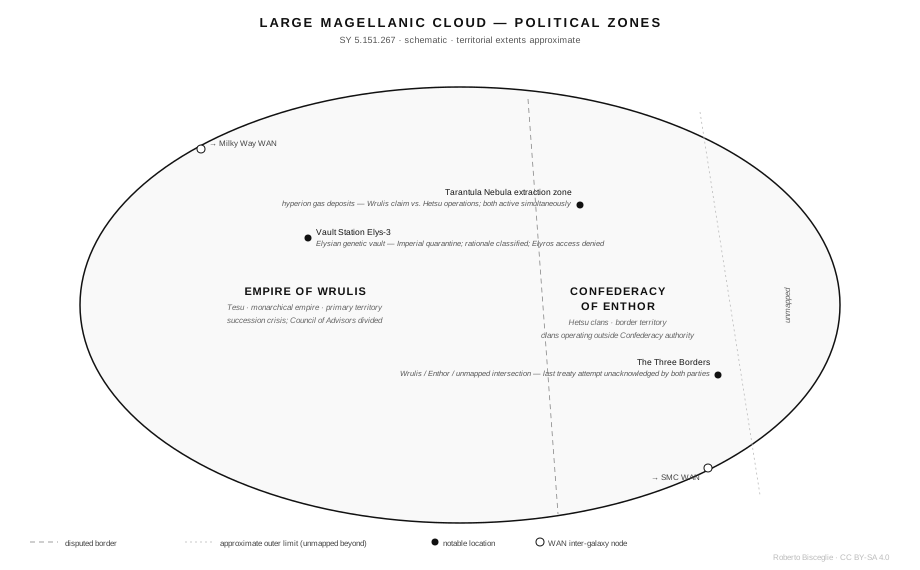
The Large Magellanic Cloud belongs to the Empire of Wrulis in the core systems and to no one reliably in the border regions, where Hetsu clans and Tesu extraction crews have been contesting the same territory for centuries.
Political climate. The Empire of Wrulis controls most of the LMC but has never incorporated the Hetsu-held border regions. The Confederacy of Enthor maintains secondary territory here alongside the Small Magellanic Cloud, and Hetsu border clans have proven more durable than any Imperial pacification campaign has managed. The current Emperor has no confirmed heir; the Council of Advisors is factionally divided; and a succession question that should be internal is becoming a regional destabilizer as outside parties begin positioning for post-transition access agreements. The Commonwealth of Elyros has been attempting to reach the Elysian genetic vaults in the LMC for decades and the Empire has not formally explained why it will not grant access.
Major powers.
Empire of Wrulis | Tesu | Monarchical empire, hereditary Emperor, Council of Advisors, Royal Guard | Core objective: territorial expansion and control of strategic resource extraction | Internal fault line: the succession question; the Council’s factional divisions have already produced two contradictory policy positions on Confederacy relations in the past year | Right now: securing the Tarantula Nebula extraction zone before Hetsu clan operations establish facts on the ground that are harder to reverse than a treaty gap
Confederacy of Enthor | Hetsu clans | Loose confederacy, clan autonomy | Core objective: preserve clan territory and prevent Imperial incorporation | Internal fault line: border clans are operating independently of Confederacy central authority, running extraction operations and access agreements without coordination; this makes the Confederacy difficult to negotiate with because any agreement may not bind the relevant party | Right now: formal Imperial recognition of three disputed border systems in exchange for a ceasefire on extraction disputes — if the Confederacy’s central body can actually deliver the relevant clans
Economic pressure. Hyperion gas, concentrated in the Tarantula Nebula region, is a fuel precursor used in WAN node maintenance. The Empire of Wrulis controls the primary deposits and uses that leverage across WAN infrastructure negotiations with other powers. The Elysian genetic vaults, sealed approximately 23,000 SY ago, contain biological engineering technology from a civilization that was more advanced than any current species in this field. Both the Empire and the Commonwealth of Elyros have independent reasons to want access; the Empire has not explained why it continues to block the Commonwealth’s survey requests.
Typical conflicts. Wrulis extraction teams and Hetsu clan patrols reaching the same resource site simultaneously, with neither authorized to be there under the other’s territorial framework. Elysian vault sites approached by multiple parties who have each obtained different and incompatible access claims from different Imperial administrative offices. Commonwealth survey ships entering LMC space on permits issued by one Imperial bureau and intercepted by a different one with no record of the permits. The factional divide in the Council of Advisors producing contradictory signals to outside parties about what the Empire will agree to.
Story register. The LMC’s dominant story register is the pressure of a large power fracturing from the top while its competitors try to benefit and its border populations try to survive the instability. The Elysian vaults represent a prize that could shift the biology of civilization — which is either an opportunity or a reason that someone sealed them from the inside, depending on what they contain.
The Council of Advisors has quietly contacted three separate outside parties about the succession question — but asked each party a different question. One was asked about legal precedent. One was asked about military alliance options. One was asked about emergency evacuation logistics. Someone in the Council is building leverage for a specific outcome. Someone else is being set up.
A Commonwealth of Elyros expedition has been operating in the Tarantula Nebula border zone for eight months on a survey permit that expired four months ago. The Empire has not revoked it. The Confederacy has not expelled them. Neither party has responded to the other’s requests to address the overstay. The expedition has not filed any reports.
Notable locations. This list is not a survey of the Large Magellanic Cloud.
- The Tarantula Nebula extraction zone — a star-forming region with hyperion gas deposits claimed by the Empire of Wrulis; the outer sections are disputed by Hetsu clans who have been operating extraction equipment there longer than the Imperial territorial claim has existed; both parties’ equipment is currently running simultaneously in adjacent sectors.
- Vault Station Elys-3 — one of the known Elysian Empire genetic vault sites, under Imperial quarantine since the order was issued by an Emperor whose specific rationale was classified; multiple parties have independent evidence suggesting the quarantine was not issued for the stated biological safety reasons.
- The Three Borders — a cluster of systems at the intersection of Wrulis Imperial territory, Confederacy clan land, and unmapped space; no stable jurisdiction has been established here; the most recent treaty attempt produced a document that neither party currently acknowledges as binding.
Small Magellanic Cloud
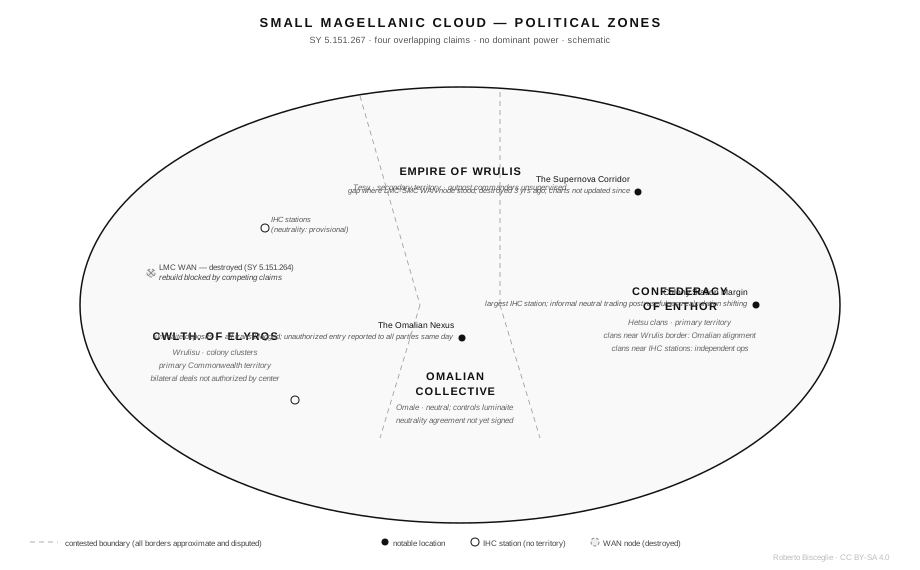
The Small Magellanic Cloud has four overlapping territorial claims, no dominant power, a galaxy that periodically destroys its own infrastructure through supernovae, and the only party with a neutral position is the one everyone needs for access to the resource they all want.
Political climate. The Empire of Wrulis and the Confederacy of Enthor both claim substantial territory here while neither can commit fully — Wrulis is managing its succession crisis and LMC border situation, Enthor is managing the same border situation from the other side. The Omalian Collective controls the primary luminaite deposits and has maintained a cooperative-neutrality stance that depends on neither Wrulis nor Enthor deciding the deposits are worth a direct confrontation. The Commonwealth of Elyros maintains Wrulisu colony clusters here as part of its primary territory, and has been developing a quiet alignment with the Omalian Collective — two cooperative societies with no military expansion ambitions, a combination that makes them complementary partners and jointly exposed if either larger power decides to test that orientation. Independent Human Colonies occupy positions of incidental strategic value — transit waypoints, refueling stations, neutral meeting grounds — which makes them useful to all parties and safe from none of them.
Major powers.
Empire of Wrulis | Tesu | Imperial, secondary territory | Core objective: establish controlling position in SMC before succession crisis constrains the Empire’s capacity for external operations | Internal fault line: same succession and Council divisions as in LMC; SMC outpost commanders are operating with even less oversight than in the Milky Way | Right now: control of the primary luminaite deposit zones, currently subject to competing claims from both the Confederacy and the Omalian Collective
Confederacy of Enthor | Hetsu clans | Loose confederacy, primary territory here | Core objective: territorial preservation; the SMC is the Confederacy’s core holding | Internal fault line: clans near the Wrulis border favor a Omalian alliance; clans near Independent Human Colony stations favor independent operations; the central body cannot reconcile these positions | Right now: formal exclusion of Wrulis military assets from three border systems, and a neutrality agreement with the Omalian Collective that the Collective has not yet signed
Omalian Collective | Omale | Cooperative governance, pack-based social structure | Core objective: maintain collective resource access and prevent forced alignment with either major power | Internal fault line: geographic pack differentiation has produced subgroups with incompatible resource priorities; the Collective’s consensus process has been deadlocked on luminaite access policy for two years | Right now: a neutrality agreement that prohibits Wrulis and Enthor from using Omalian space as staging ground — the Collective has not signed Enthor’s proposed version because it does not include equivalent Wrulis restrictions
Commonwealth of Elyros | Wrulisu | Cooperative colony governance, SMC colonies administered with partial autonomy from Triangulum | Core objective: preserve SMC colony autonomy within the Commonwealth framework | Internal fault line: geographic isolation from Triangulum administration has allowed SMC colony councils to negotiate bilateral resource agreements with both the Empire and the Confederacy independently, creating obligations the Commonwealth center did not authorize | Right now: a formal cooperative arrangement with the Omalian Collective to present a non-aligned front — the Collective has been receptive but has not committed, citing its unresolved internal deadlock on luminaite policy
Independent Human Colonies | Human | No unified governance; individual colony administrations | Core objective: survival and neutrality | Internal fault line: no unified representation means each colony negotiates independently, which produces contradictory agreements with competing powers | Right now: neutrality guarantees from all three major powers; individual colonies are getting them from whichever party approaches first, which is not the same thing
Economic pressure. Luminaite and astralite crystals, found primarily in the Omalian Collective’s home cluster, have unique properties used in certain navigation systems. Both the Empire and the Confederacy need access to deposits they do not control, which is the entire basis of the Omalian Collective’s current security. Frequent supernovae disrupt established routes and destroy infrastructure on a timescale measured in years; the WAN node linking the SMC to the LMC was destroyed by a supernova three years ago and has not been rebuilt, because all three parties with the technical capacity to do so are also the parties disputing who would control the rebuilt node.
Typical conflicts. Wrulis and Confederacy forces using the same human colony stations for resupply without coordinating, then discovering each other there. Omalian Collective packs unilaterally closing access to home systems in response to external pressure that the Collective’s central body did not authorize them to respond to. Supernova disruptions rerouting traffic through contested space where three different sets of transit protocols apply simultaneously. Human colonies that agreed to neutrality with one party being approached by a second party with a better offer and no mechanism to enforce the first agreement.
Story register. The SMC’s physical instability means the map is always slightly wrong. A route that worked last month may not exist this month. The political instability means that any agreement is provisional. Stories here tend toward the operational and the small-scale — the correct bribe, the right moment to leave, the colony administrator who knows something they shouldn’t. The large-scale story is the Omalian neutrality, which is one miscalculation away from collapsing into the first full Wrulis-Enthor war in three generations.
The destroyed WAN node linking the SMC to the LMC has been dark for three years. All three parties with the capacity to rebuild it have filed competing claims through the inter-polity arbitration registry. None has started construction. An independent operator with the technical expertise and a neutral registration could offer to rebuild it — and would immediately become the most important and most threatened person in the SMC.
One of the Independent Human Colonies has been transmitting on an encrypted frequency for at least six months. The signal predates the colony’s official founding date. The Omalian Collective received the signal first and has not disclosed its contents. The colony’s administrator has not responded to any inquiries about the signal, including one from the Terran Compact’s diplomatic office.
Notable locations. This list is not a survey of the Small Magellanic Cloud.
- The Omalian Nexus — the Omalian Collective’s primary cluster, controlling access to the largest luminaite deposits in the SMC; officially neutral, with the practical condition that any vessel entering without Collective authorization is logged and that log is distributed to all interested parties within the day.
- The Supernova Corridor — the unpatrolled gap where the destroyed LMC-SMC WAN node used to be; operators who use it avoid transit records and the official hazard warnings, in exchange for outdated charts and the genuine possibility that the corridor’s navigational data has not been updated since the event that destroyed the node.
- Colony Station Margin — the largest Independent Human Colony in the SMC, operating as an informal neutral trading post; its neutrality is maintained by its usefulness to all parties, and the calculation of that usefulness has been shifting as each major power’s priorities change.
Major Species
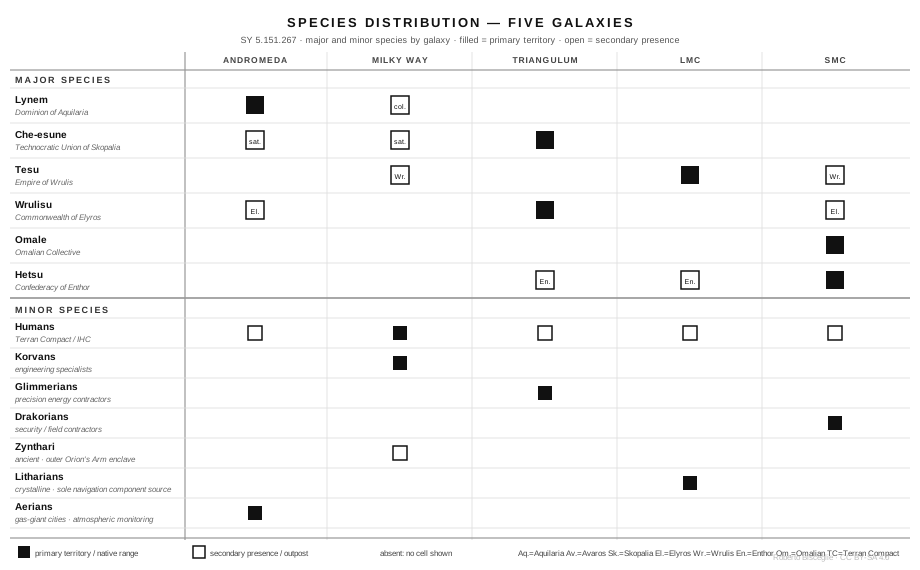
Six species dominate the political and demographic landscape of the Five Galaxies. They are described here as they exist under current conditions — under resource pressure, with active internal conflicts, and in ongoing friction with each other and the wider galaxy. Each entry covers what is observable, what is contested, and what remains unknown.
Lynem
Visual signature. The Lynem are compact humanoids averaging 3 feet tall, with pangolin-plated heads, paired octopus eyes that move independently of each other, and bat-shaped ears that flatten visibly when the Lynem is bored or offended. The body is covered in dense fur — sky blue with dark blue speckles across most of the torso, shifting to vivid green with spiral markings on the lower limbs. The silhouette is unremarkable until the face is visible.
Society under pressure. Lynem society organizes around paternal lineage: males raise the young and the bond between a father and his offspring is the primary social unit. When resources tighten or borders are contested, Lynem communities contract inward — access to their territory narrows, external negotiations slow, and non-Lynem are reclassified from tolerated to conditionally present without announcement. Outsiders who have previously held unrestricted station access report losing it without explanation during resource disputes. The shift is not announced; requests that were previously routine simply stop being answered. Material culture is not decorative: Lynem sculpture, metalwork, and ceremonial objects denote lineage, signal status, and formalize agreements. A contract negotiated without the correct ceremonial markers is considered incomplete by any Lynem party to it, which is information that most non-Lynem learn several failed transactions too late.
Internal fractures. The primary fracture in Lynem society runs between the male-led paternal networks — which control resource allocation and diplomatic relationships within communities — and an organized movement of Lynem females who have established commercial collectives operating entirely outside the paternal network structure. The collectives are legally recognized within Lynem-controlled space but socially marginal. Outside Lynem territory, where the paternal network’s authority does not reach, the collectives have built independent trade relationships that the Dominion of Aquilaria has not sanctioned. The result is a two-track Lynem diplomatic presence in the wider galaxy: the formal Dominion channels and the informal collective channels, which operate with different priorities, different prices, and incompatible commitments.
How outsiders experience them. Entering a negotiation with Lynem representatives requires patience with a process that is meticulous to the point of feeling deliberate. They ask questions before making offers. They note inconsistencies between what a counterpart has said across multiple meetings and reference them later, without signaling that they have been tracking. Outsiders who skip formalities — or arrive without expected preliminary documentation — find that meetings are productive in tone and reach no conclusions. Lynem separate warmth in a meeting from commitment to a deal; the two are not related, and experienced counterparts stop treating them as if they are.
What they want from the wider galaxy. The Dominion of Aquilaria wants territorial consolidation and continued control of approaches to Celestial Dominion ruins in Andromeda. The female collectives want market access and the legal standing in external jurisdictions that would let them operate without routing through Dominion channels. These goals are in tension with each other, which creates persistent ambiguity about which Lynem entity any given agreement is actually with.
Friction point. The Lynem female collectives have been operating as independent trade intermediaries in the Milky Way for approximately two decades, bypassing Aquilarian trade routes and building relationships with Avaros member species that the Dominion has not authorized. The Dominion has not moved against this. The internal pressure to act is building. Any outside party that has built working relationships with the collectives is operating on a timeline that only the Dominion controls.
Che-esune
Visual signature. The Che-esune are medium humanoids at 5 feet, with horse-shaped heads, dog-like ears, and a bottlenose dolphin snout that functions primarily as a scent organ. They are entirely blind — the eye sockets are sealed — and navigate through scent and echolocation clicks produced at a frequency not always audible to other species. The skin is rubbery, half sandy brown with green speckles and half black-and-light-blue separated by a thin gray line; the lower body shifts to beige with green diamond patterns. Despite the otherwise mammalian silhouette, the skin texture is distinctly non-mammalian.
Society under pressure. Che-esune social structure centers on the breeding pack: a mated pair — males mate for life; females are opportunistically promiscuous but manage this within the pack structure — leading a large multi-generational group. When resources become scarce or external threats appear, the pack contracts through a specific behavioral sequence: external access closes first, then internal hierarchy tightens, then young adult males are pushed outward to establish satellite groups in adjacent territory. This last behavior is framed culturally as a rite of passage rather than expulsion, but satellite groups in contested regions function as advance positions that the core pack can plausibly disavow. The Che-esune govern territory through scent marking that other species cannot detect, which means that non-Che-esune frequently violate territorial boundaries without knowing it and then encounter a defensive response that appears to come without warning.
Internal fractures. Satellite male groups pushed outward over generations have developed into distinct pack cultures, several of which have built alliances with non-Che-esune species outside the Technocratic Union’s governance structure. The deepest fracture in current Skopalian politics runs between the establishment — core breeding packs with multi-generational institutional presence in Triangulum — and the satellite factions, which are numerically larger, geographically broader, and increasingly resentful of being treated as subordinate. The establishment controls the Union’s formal institutions; the satellite factions control most of the Union’s actual population. This gap is not publicly described in those terms within Skopalian governance, but it shapes every policy dispute about resource allocation and technology access.
How outsiders experience them. Working with Che-esune means accepting that some of the information they are working from is not available to you — not deliberately withheld, but genuinely imperceptible. A Che-esune patrol reporting that a corridor is clear is reporting accurately based on scent data other species cannot verify. A Che-esune negotiator who seems agreeable may be registering something chemically that is shaping their assessment in ways they could describe if asked but typically don’t volunteer. Most species that work regularly with Che-esune develop the habit of asking directly what the Che-esune is sensing, rather than reading behavioral cues and getting the interpretation wrong.
What they want from the wider galaxy. The Technocratic Union of Skopalia wants to maintain its technological advantage — exclusive access to pre-collapse research, control of gravitite and plasmonic crystal deposits, and the ability to set the terms of technology transfer. The satellite factions want access to what the Union controls but doesn’t share with them. Neither goal is stated in those terms in any official communication.
Friction point. The largest Che-esune satellite faction in the Milky Way has been trading technology outside Skopalian export controls for approximately eighty years, using intermediaries who cannot be traced to the Union. The Technocratic Union is aware of this and has taken no action. Whether this is because the faction has leverage over the Union, because the Union cannot reach it, or because the arrangement is unofficially tolerated has not been determined by any outside party.
Tesu
Visual signature. The Tesu are large octopedal reptiles averaging 7 feet at the shoulder, with feathered bodies in cream, dark brown, and ochre, and paired indigo eyes that retract completely into the skull — leaving a smooth sealed surface — within a fraction of a second. Eight short legs produce a lateral gait; the vestigial wings function only as behavioral displays. The jaw is long with blunt teeth. When a Tesu retracts its eyes, it has decided it does not want to be observed. This is widely understood as a signal worth heeding.
Society under pressure. Tesu form temporary pair bonds for each breeding cycle and dissolve them afterward. Females compete for males during breeding season; the young leave family groups at maturity. The practical result is a species with strong individual adaptation capacity and weak institutional loyalty. When environments change, Tesu individuals respond faster than their governance structures can — which means that Tesu polities are perpetually managing the gap between what their subjects are doing and what policy says they should do. The Empire of Wrulis is the primary Tesu political structure, and its central management problem is that Tesu in frontier regions adapt to local conditions in ways that diverge from Imperial policy, then negotiate privately to keep those adaptations from being officially acknowledged. The Empire has historically managed this by treating frontier divergence as invisible until it becomes strategically useful or untenable.
Internal fractures. Two broad factions have been developing for generations. The Imperial traditionalist bloc consists of Tesu who have held established positions long enough to have multi-generational property rights and institutional stakes in stability. The frontier population — called “adapters” within that community, though they do not use the term formally — treats Imperial policy as a starting point rather than a constraint. The adapters are not politically organized and do not identify as a faction, which is precisely what makes them difficult for the Empire to manage. The Confederacy of Enthor has been extending quiet offers to frontier Tesu that Imperial law would not permit: resource shares, territorial arrangements, and bilateral agreements that exist outside the Imperial treaty structure.
How outsiders experience them. Tesu are effective at making counterparts feel comfortable in negotiation and then shifting position rapidly without acknowledging the shift. From the Tesu perspective, each successive position is the correct response to current conditions; this is not experienced as inconsistency. Outsiders who draft agreements with Tesu counterparts need language that specifies not just what is agreed but under what conditions the agreement remains in force, because a Tesu will not consider a change in circumstances to invalidate an agreement made under different conditions — and will be genuinely confused when the other party treats it as a breach.
What they want from the wider galaxy. The Empire of Wrulis wants resource extraction rights and territorial consolidation in the LMC and SMC. Individual frontier Tesu want autonomy to operate outside Imperial reach while retaining the ability to invoke Imperial protection when it becomes convenient. These goals are in tension, and that tension is the Empire’s primary internal management challenge.
Friction point. The Confederacy of Enthor has been recruiting frontier Tesu into extraction operations in disputed LMC border zones, offering resource shares that the Empire’s tax structure would capture. The Empire is aware of this. It has not acted, because the frontier Tesu involved are in territory the Empire cannot securely hold, and acting against them would make visible the extent to which the Empire does not control its own border.
Wrulisu
Visual signature. The Wrulisu are enormous avian bipeds — 87 feet tall on average — with salmon-pink feline eyes, wide heads, and a heavy top-loading beak that appears slightly mismatched with the thin neck below it. The body is covered in rigid ochre feathers; the stubby arms are functionally useless for fine manipulation and serve primarily as display surfaces. At this scale, moving through most interspecies environments requires infrastructure built to accommodate them, and Wrulisu who operate in mixed-species contexts do so in spaces specifically adapted for their presence.
Society under pressure. Wrulisu family groups are headed by the eldest male, whose authority within the group is near-absolute. Males fight to the death for breeding rights when they reach breeding age; the winner takes a place in a family group while the loser is removed from the breeding population permanently. Young males leaving their birth families enter a socially unattached period during which they are economically marginal and behaviorally unpredictable — and must either win their way into an existing family group or establish a new one. When resources become scarce, family groups enforce territorial boundaries more aggressively, reduce outsider access, and insulate the grandfather’s decisions from internal challenge. Groups with intact grandfather lineages going back multiple generations survive resource stress better than groups that lost their grandfather in the previous generation; the latter are structurally weaker and are absorbed or displaced at higher rates during scarcity periods.
Internal fractures. Family lineage factions are the primary division in Wrulisu society, and several hold incompatible positions on the Commonwealth of Elyros’s governance questions — particularly how much autonomy individual colonies should have, and whether the Commonwealth should maintain formal alignment with the Technocratic Union of Skopalia. Several Andromeda lineages have been drifting toward positions that would justify bilateral agreements with the Dominion of Aquilaria; other lineages consider this a structural betrayal of Commonwealth founding principles. The Commonwealth’s governance requires consensus, which makes this lineage disagreement a practical paralysis on the relevant policy questions. Both sides are correct that the other side’s position, if adopted, would be irreversible.
How outsiders experience them. The Wrulisu tendency to acquire objects they find interesting — and to hold them — is well documented. The behavior reads as theft to most species but is better understood as a form of attention that has not yet processed the relevant social conventions around ownership. On Wrulisu-run stations, travelers are advised to keep valued objects on their person or secured, not because Wrulisu are criminally inclined but because the return process, once an item has been taken for examination, involves a formal inquiry that can take days. In formal negotiations, a Wrulisu’s sudden interest in a specific contract term signals something; interpreters disagree on whether the signal is genuine interest in that term or concern about something adjacent to it.
What they want from the wider galaxy. The Commonwealth of Elyros wants territorial security and maintenance of its cooperative model across the Triangulum and SMC territories. The lineage factions want different things and the lineage that controls current Commonwealth policy is not stable. At the species level, the Wrulisu want political recognition proportional to their territorial span, which they currently do not have in multi-polity negotiations.
Friction point. A Wrulisu family group operating in the LMC near the Elysian vault sites — nominally as part of a Commonwealth of Elyros survey mission — has filed no reports with the Commonwealth for four months. The Empire of Wrulis has not moved against them, which is unusual. Whether the family group is still operating under Commonwealth authority, under private arrangements with the Empire, or on its own initiative is not currently known to the Commonwealth or to anyone who has been asked.
Omale
Visual signature. The Omale are large invertebrates — 34 feet tall — with oval heads, medium-length antennae in near-constant motion, and paired mandibles that function as both manipulators and threat displays. No arms; the thorax is narrow, wasp-waisted, connecting to a small rounded abdomen. A single bony leg provides locomotion. The body is covered in spikes and dense hairs, metallic grey with light green stripes. The profile is deeply unfamiliar to most species at first encounter, and most initial Omale-outsider contact involves a longer mutual assessment period than either side expects.
Society under pressure. Omale packs are led by dominant individuals whose authority is established through demonstrated capacity rather than heredity. Pack decisions are collective — members state positions until a dominant consensus forms — but the process runs faster than it appears because Omale packs maintain a secondary communication layer through antennal signaling that leadership reads continuously during deliberation. When threats appear, packs shift from collective process to command authority rapidly; the transition is not announced and outsiders who expect a warning frequently miss it. The Omale’s primary defensive mechanism — spitting a foul-smelling fluid that adheres to most materials and resists neutralization — is deployed as a final warning rather than an opening one. By the time a pack is using it, the negotiation has already failed.
Internal fractures. Pack geography has produced substantially different Omale subgroups. Within the Omalian Collective in the SMC, the deepest fracture is between coastal packs — which have access to fungal-rich environments and have developed resource surpluses — and interior packs that operate at resource margins and treat any surplus pooling as a threat to their own future security. The Collective’s consensus process has been deadlocked on luminaite access policy for two years because these factions cannot reconcile their positions. Exterior Omale populations that left the SMC in earlier generations have developed cultural practices the Collective considers irregular but cannot effectively govern at inter-galaxy distances.
How outsiders experience them. Omale packs treat first contact with any new party as an extended assessment period: questions, observations, and a pack-consensus judgment before substantive engagement. Parties that arrive expecting to negotiate immediately find the process feels interrogative. From the Omale perspective, committing to anything before the assessment is complete is how packs historically ended up in arrangements they couldn’t exit. On shared stations, the foul-smelling fluid is a practical concern: it persists for days on most surfaces, and several common station materials cannot neutralize it. Stations with regular Omale traffic post specific handling protocols.
What they want from the wider galaxy. The Omalian Collective’s primary interest is maintaining the leverage that the luminaite deposits provide — which requires keeping both the Empire of Wrulis and the Confederacy of Enthor in a position where they need access the Collective controls. This means not aligning formally with either, which the Collective wants formalized as a treaty obligation that neither party has agreed to. At the pack level, Omale want resource autonomy and territorial expansion rights that larger polities have not granted.
Friction point. The Omalian Collective has been in quiet dialogue with the Commonwealth of Elyros about a non-aggression and resource-sharing arrangement that would constitute a non-aligned bloc in the SMC. Neither party has disclosed these talks. Both the Empire of Wrulis and the Confederacy of Enthor have intelligence indicating the talks are occurring; neither has publicly acknowledged this. What the arrangement would mean for luminaite access — and whether it would trigger a preemptive move from either larger power — is the central unresolved question.
Hetsu
Visual signature. The Hetsu are large bipeds — 16 feet — covered in shaggy purple fur. The head is ridged and spiked, with two wide eyes positioned on the back of the skull — the Hetsu’s primary visual field faces behind them — a long trunk used for manipulation and scent-gathering, and paired mandibles capable of significant mechanical force. The front-facing aspect of the head has no eyes, only trunk and mandibles, which creates a disconcerting appearance for species accustomed to forward-facing vision.
Society under pressure. Hetsu males raise young alone after the breeding season; the mother provides no post-breeding investment. This makes the male-offspring bond the primary social relationship, producing adults who are territorial in direct proportion to what they personally built and defended — not abstractly, but specifically and traceable to individual effort. When borders are threatened or resources constrained, Hetsu escalate through a predictable sequence: first, increased patrolling; then, a formalized challenge that signals the approaching party has been identified; then violence, without further warning. The challenge stage is visible to parties who know what to look for. Outsiders who miss it consistently are surprised by what follows.
Internal fractures. The Confederacy of Enthor is a loose clan structure, and clans in different environments have developed substantially different governance approaches, resource strategies, and external relationships. The deepest current fracture runs between the Triangulum Hetsusian Enclave clans — who have access to Xalith ruins and have been monetizing that access independently — and the SMC core clans, who hold the Confederacy’s primary territory and are managing the active border dispute with the Empire of Wrulis. The Enclave clans’ revenue from unauthorized survey access has made them financially independent from the Confederacy’s collective resource structure. The SMC clans regard this as a long-term threat to collective defense. The Confederacy’s central body cannot resolve this because both factions hold blocking positions in the representative gathering.
How outsiders experience them. Reaching any agreement that involves the Confederacy of Enthor requires confirming which clan’s territory is actually relevant — and then confirming that the clan recognizes the Confederacy’s authority to speak for it on the specific question at hand. Both are harder to confirm than they appear. The Confederacy’s representative gathering maintains a roster of member clans, but the roster has not been audited in decades and several listed clans have fragmented into sub-clans whose relationship to the Confederacy is ambiguous. Brokers who work regularly in Hetsu space recommend negotiating directly with the specific clan rather than the Confederacy, and building the agreement in terms the clan’s territorial logic recognizes rather than the Confederacy’s formal framework.
What they want from the wider galaxy. The Confederacy of Enthor’s formal position is territorial recognition and non-interference from larger polities. In practice, Enclave clans want to continue selling Xalith site access without interference from Skopalia or the Confederacy’s central body; SMC clans want formal exclusion of Wrulis military assets from border regions. No Confederacy-level position reconciles these.
Friction point. A Hetsusian Enclave clan has been selling access to a specific Xalith site to three separate parties simultaneously — a Skopalian research team, an Avaros academic expedition, and a third party whose registration documents appear to be fabricated. The clan has not disclosed the simultaneous access to any of them. The site in question is the same location that Survey Expedition SY-7 was approaching when its transmissions were classified by the Technocratic Union.
Minor Species
The Five Galaxies contain far more species than are represented in this compendium. The seven entries below have established functional presences in Charted Space and have become relevant to wider galactic operations — as specialists others depend on, as communities occupying contested positions, or as individuals working in circumstances that major species prefer not to be associated with.
Korvans
The Korvans are small insectoids native to the Milky Way, with colonies concentrated in systems where complex infrastructure demands continuous maintenance. Their understanding of mechanical systems, robotics, and AI architecture exceeds most species at the practitioner level, and Korvan-built systems are known for efficiency and for being difficult to maintain without Korvan assistance. Most Korvan engineering contains proprietary design elements that cannot be reverse-engineered without Korvan involvement — not by accident. Korvan engineering collectives hold service contracts for dozens of WAN-adjacent stations and critical industrial facilities, with provisions that make switching providers more expensive than renewal. The leverage this creates is politely ignored in diplomatic contexts and intensely relevant whenever a contracted system develops a problem its operators cannot diagnose.
A WAN maintenance station in the Milky Way has been running on a Korvan-built automated management system for forty years. The collective that built it dissolved eighteen years ago. The system has begun producing outputs that no one on staff can interpret, and the only Korvan engineer who may understand the original architecture has not responded to contact in three months.
Glimmerians
The Glimmerians are a luminescent species distributed across a scattered network of stations and specialist facilities in the Triangulum Galaxy, without a unified home territory or governing body. They emit a soft bioluminescent glow that intensifies during periods of heightened focus — in a darkened room, they are impossible to conceal. Their primary niche is precision energy work: shielding calibration, power system management, energy-based weapons maintenance, at a level of precision that most species cannot replicate without specialized tooling. Glimmerian contractors are in demand across all five galaxies for operations where standard shielding is inadequate. They tend to work alone or in pairs. Their services are expensive, and they have a documented pattern of walking off a job when they assess the remaining work to be more dangerous than the contracted price reflects — leaving whatever they were working on in whatever state it was in when they left.
A Glimmerian specialist was hired to recalibrate the energy shielding on a Skopalian research installation in Triangulum. She completed the work ahead of schedule and departed. The installation’s power management system is now drawing six times its rated capacity and the research team cannot shut it down. The Glimmerian has not been located.
Drakorians
Drakorians are a reptilian species from the Small Magellanic Cloud, built for stealth: natural camouflage that matches most common station surfaces and atmospheric environments, physical agility suited for close-quarters work, and sensory acuity specialized for tracking. They do not operate a unified polity; most Drakorians encountered outside the SMC are independent contractors working in security, surveillance, and what their clients call field acquisition. They take contracts that registered firms cannot accept without legal exposure, in environments that registered firms prefer not to enter. They are in demand because they succeed at what they are hired to do. The risk is not failure — it is that Drakorians retain detailed memory of everything they observe during a contract, and their professional discretion is contractual, not absolute.
A Drakorian was hired eight months ago to retrieve a specific data package from a facility in the SMC. The client received the package and the contract was closed. Three weeks later, a second party approached the original client asking about the same package. The Drakorian has not reappeared, but someone is using their identity credentials to book transit across the SMC.
Humans
Humans are a minor species. The Terran Compact governs Orion’s Arm territory in the Milky Way — administrative weight at Nova Terra in the Chara system, formal institutional authority at Earth, neither settled — and beyond that margin, human settlements are independent colonies, station communities, diaspora populations absorbed into larger polities, and individuals working in whatever capacity local employment supports. There is no species-wide human agenda. Biologically adaptable and linguistically flexible, humans are also short-lived by the standards of species with 150-year lifespans — which produces a risk tolerance that longer-lived species read variously as useful, unreliable, or dangerous depending on context. They appear in more roles and more locations than their demographic weight would predict, which means they are frequently present in situations where they have learned things they were not supposed to learn. This is not an inherent human quality; it is a consequence of being willing to take the jobs that others are not.
An independent human colony in the Small Magellanic Cloud sits on the only viable approach vector to a recently disrupted WAN corridor. Every major power operating in the SMC has made the colony’s administrator an offer. She has accepted none of them. Her counter-proposal, sent simultaneously to all three parties, has not been disclosed publicly — but all three parties have continued negotiating, which suggests the proposal is serious.
Zynthari
The Zynthari are an ancient species occupying a defined enclave at the outer rim of Orion’s Arm in the Milky Way. Their physical form holds imprecisely in space — biology that interacts with spacetime at a slight offset from conventional matter; outlines sharp, internal depth inconsistent, the effect intensifying in proximity. Their technology operates on principles neither human nor galactic-standard science has characterized, and they have declined to explain it.
They do not expand. They monitor. The Rim Concord, concluded after a brief and devastating conflict with the Terran Compact, defines restricted zones in the outer Milky Way that no Compact vessel may enter — several containing Precursor ruins, several containing nothing that documented surveys can identify. Their connection to the Precursor civilization is suspected but unconfirmed; their age predates the oldest reliable Milky Way records. Avaros serves as their diplomatic relay without being formally acknowledged as a party to anything. Most galactic powers outside the Milky Way have heard of the Zynthari and have not encountered them.
An Avaros academic expedition recently received a Zynthari communication through a diplomatic channel it had not provided to any party and which does not appear in any public registry. The message requested the expedition document its findings and transmit them to a specified address before departing the system. The expedition complied. The address does not match any known Zynthari contact point, and the expedition’s lead researcher has declined to discuss it.
Litharians
Litharians are a crystalline species native to the Large Magellanic Cloud, inhabiting deep cave networks in systems with geological conditions they have not permitted outside parties to survey. Their bodies are composed of living mineral structures that grow throughout their lifespan and are periodically shed; these shed components have electromagnetic properties that make them irreplaceable in specific navigation and power-coupling applications. No synthetic equivalent has been produced at industrial scale. This makes the Litharians the sole source of a material that several major systems depend on, a position they are fully aware of and which shapes every interaction they have with outside parties. They do not maintain a military, a WAN node, or a diplomatic office. They maintain supply agreements, and those agreements have not been violated — yet.
A Litharian cave complex in the LMC sits beneath a systems boundary that the Empire of Wrulis and the Confederacy of Enthor have been disputing for four decades. Both parties have offered the Litharians increasingly favorable supply terms. The Litharians have accepted neither and have begun routing their exports through Omalian Collective space instead. Neither disputing party has publicly responded to this development.
Aerians
The Aerians are avian beings native to the Andromeda Galaxy, building their primary settlements as floating platform cities in the upper atmospheric layers of gas giants and high-altitude planets. Their sensory range and physical mobility in atmospheric environments exceed any species operating from surfaces or orbital platforms. Aerian atmospheric monitoring systems — combining their biological sensory data with engineered sensor networks — provide early warning coverage for weather events, debris fields, and unauthorized vehicle approach that satellite networks cannot replicate at comparable cost. Major governments and private operators purchase this data, which makes the Aerians simultaneously a service provider and a persistent intelligence source. They observe continuously. They record what they observe. They sell that data — and they sell it to more than one party, a practice they do not advertise and have not been successfully pressured to change.
An Aerian floating city has been adjusting its position and altitude over a Celestial Dominion ruin site in Andromeda for the past fourteen months, maintaining optimal observation coverage of the site. The Aquilarian exclusion perimeter around the ruin is ground-level. The Aerians are above it. No party has publicly asked what they are observing or who is purchasing the data.
Major Empires and Powers
Six polities dominate the political structure of the Five Galaxies. Each holds power differently and is losing it differently. These profiles describe current state: what each power is pursuing, what it depends on, what it is hiding, and what it will offer to someone who can be useful.
Faction Relationships
Six major polities, three minor ones, and the relationships that define who can go where and at what cost. Solid lines are treaties or cooperation. Dashed lines are active disputes or rivalries. Arrows show direction of constraint or dependency.
graph TD
    AQ["**Dominion of Aquilaria**<br/>Lynem · Andromeda"]
    AV["**United Federation of Avaros**<br/>Multispecies · Milky Way"]
    SK["**Technocratic Union of Skopalia**<br/>Che-esune · Triangulum"]
    EL["**Commonwealth of Elyros**<br/>Wrulisu · Triangulum / SMC"]
    WR["**Empire of Wrulis**<br/>Tesu · LMC"]
    EN["**Confederacy of Enthor**<br/>Hetsu · SMC / LMC"]
    TC["**Terran Compact**<br/>Human · Milky Way"]
    OM["**Omalian Collective**<br/>Omale · SMC"]
    ZY["**Zynthari**<br/>ancient · Milky Way outer rim"]

    AQ -. "adversarial equilibrium<br/>(centuries)" .- AV
    AQ -. "rivals: ruins access<br/>40-yr blockade" .- SK
    AQ -. "blocks colony recognition" .- EL
    SK -- "nominally cooperative<br/>(fracturing)" --- EL
    EL -- "quiet alignment<br/>(non-aligned bloc)" --- OM
    EL -- "overlapping territory" --- EN
    AV -. "containment pressure" .- WR
    WR -. "border dispute · 40 yr" .- EN
    AV -->|"diplomatic relay"| ZY
    ZY -- "Rim Concord<br/>(constrains Compact)" --- TC
Dominion of Aquilaria
Core objective. Establish and maintain Lynem cultural primacy across the Andromeda Galaxy while expanding exclusive control of Celestial Dominion ruin access — the two goals are related, because the ruins represent pre-collapse technology that would break the Dominion’s technological edge if any other power reached it first.
Current strategic priority. Locking in exclusive access to Celestial Dominion megastructure sites before Skopalian survey teams can document their contents. The Aquilarian Royal Navy has placed exclusion perimeters around four major sites in the past two years. The rationale given — structural preservation — has no treaty basis. The Technocratic Union has filed formal challenges. The Dominion has not responded to any of them.
Resource base. Aquatic habitat infrastructure across the Andromeda belt: no other power can operate at depth without Aquilarian permits, which gives the Dominion economic leverage over every species with underwater resource interests in the galaxy. Asteroid belt rare minerals adjacent to Celestial Dominion sites. Medicinal biotech compounds from surveyed ecospheres, extracted under Aquilarian licensing at prices the Dominion sets unilaterally.
Internal fault line. Noble houses compete with the military officer corps for policy influence over the monarch. The current monarch’s health is not disclosed to outside parties, and succession protocols are contested between a noble bloc that wants a civilian regency council and a military bloc that wants a command authority structure. The two sides have been positioning for approximately three years. A resolution requires the monarch to name a successor, which the monarch has not done.
Primary rival. The Technocratic Union of Skopalia — specifically over access to the Celestial Dominion sites and the minerals in the Aquilarian Sacred Belt. Skopalia has four unresolved treaty challenges. The Dominion’s strategy has been to delay proceedings rather than engage their substance, on the calculation that Skopalia’s internal fractures will force a concession before the Dominion’s exclusion posture costs it something it cannot afford to lose. That calculation has held for forty years.
Frontier behavior. In outer Andromeda belt systems, the Dominion operates through franchised noble houses whose charters allow substantial autonomous action. These houses conduct territorial enforcement, sign resource extraction agreements, and occasionally engage in military operations that would trigger diplomatic consequences if attributed to the central government. The Dominion acknowledges the houses’ actions when they are successful and disavows them when they are not.
What it offers outsiders. Transit permits for Andromeda routes (required for most of the galaxy’s infrastructure access), aquatic habitat access rights, and trade licensing for Aquilarian biotech compounds. The price is acknowledgment of Lynem cultural primacy in negotiation settings, exclusive purchase commitments on technology imports, and implicit reporting requirements — the Dominion tracks its partners’ external relationships and will use that information when it becomes relevant.
United Federation of Avaros
Core objective. Maintain a governance framework in the Milky Way where no single species holds permanent structural dominance — and keep that framework viable as the two powers most interested in bypassing it continue to probe its edges.
Current strategic priority. A treaty revision with both the Dominion of Aquilaria and the Empire of Wrulis that closes the border agreement gaps both powers have been using to expand without triggering formal disputes. The Federation’s Council has been unable to ratify its own negotiating position for four years. The member species deadlock is not accidental: species whose territories border the gaps have contradictory interests in whether those gaps close.
Resource base. Trade network infrastructure — the most densely serviced WAN route cluster in any single galaxy, across the Milky Way and extending into Triangulum and the Large Magellanic Cloud. The Federation does not control raw resources so much as it controls access: transit fees and route licensing constitute its primary revenue. This base is stable only as long as trade volume remains high. A prolonged political confrontation with a major power would erode it faster than any military engagement.
Internal fault line. The rotating species leadership structure produces policy reversal between cycles. Species that held unfavorable trade terms during a previous cycle renegotiate them when their turn in leadership arrives. The Federation has not maintained a consistent position on any contested question for longer than a generation. External parties that understand this use it deliberately — a concession extracted from one leadership cycle can be reversed by appealing to the next.
Primary rival. The Technocratic Union of Skopalia — specifically over the resource allocation question in the Triangulum-Milky Way border systems. Federation policy requires survey data sharing from operators on its routes; Skopalia circumvents this through satellite factions and third-party intermediaries. The Federation has documentation. It has not acted on it, because acting would require the current Council to agree on an enforcement approach, which the current Council cannot do.
Frontier behavior. At the edges of its territory, the Federation issues permits, registers claims, and files disputes. It does not and will not deploy military force for anything below the threshold of a formal territorial invasion. Below that threshold, frontier situations are managed through administrative processes that both disputing parties generate paperwork into faster than the Federation can resolve it. The backlog is measured in decades.
What it offers outsiders. The most extensive neutral trade route access in the Five Galaxies; diplomatic recognition that carries weight across species lines; and an arbitration process that has a reasonable track record of producing agreements that hold — at least for the duration of the current leadership cycle. The price is transparency: survey data sharing, cargo disclosure, travel manifests, and the understanding that any arrangement made with a Federation partner will be visible to the Federation’s administrative apparatus and potentially to whoever holds leadership in the next cycle.
Technocratic Union of Skopalia
Core objective. Maintain technological monopoly through exclusive control of pre-collapse research access and strategic mineral deposits — specifically the gravitite and plasmonic crystal supply that gives it infrastructure leverage over WAN maintenance processes.
Current strategic priority. Suppressing, classifying, and buying out every channel through which Survey Expedition SY-7’s findings might surface. The Union has classified the expedition’s prior transmissions, restricted access to the coordinates SY-7 used, and has been quietly acquiring independent research institutions that might reconstruct the expedition’s data from secondary sources. This process is expensive, imperfect, and ongoing.
Resource base. Gravitite and plasmonic crystal deposits in Triangulum — essential for WAN node maintenance, giving Skopalia leverage over the infrastructure that every other power depends on. The most technically sophisticated AI and robotics research institutions in the Five Galaxies. Export-controlled technology licensing that generates revenue proportional to how dependent other polities have become on Skopalian-developed systems.
Internal fault line. An entrenched senior research tier has calcified into a governance bloc that benefits from the current monopoly structure and blocks proposals for broader access. Capable Che-esune researchers have been leaving Union institutions for Avaros-affiliated facilities for approximately twenty years. The Union classifies their published work when possible. It has not changed the institutional policies driving the departures. The satellite faction populations — numerically larger than the Union’s core — are increasingly resentful of an arrangement that takes their labor and denies their authority.
Primary rival. The Dominion of Aquilaria — over access to Celestial Dominion megastructure sites in Andromeda. Skopalia is funding research through Avaros academic channels in the hope that independent work will surface Celestial Dominion information it can access without being seen to have obtained it directly. Whether this strategy is producing results the Union is acting on has not been confirmed externally.
Frontier behavior. In systems adjacent to the Triangulum core, Skopalia maintains research outposts registered as “monitoring stations.” These facilities conduct surveys, collect astronomical data, and — in several documented cases — have been used to intercept communications from neighboring polities. The Union has not responded to formal inquiries about these functions. Operators who use Skopalian-adjacent transit routes should assume their communications are being logged.
What it offers outsiders. Access to the most advanced technology licensing available from any registered power; research partnerships with Union facilities, including access to gravitite-dependent equipment that no other power can supply; and employment for individuals whose credentials the Union’s meritocratic structure can recognize. The price is that any research conducted under Union partnership is subject to classification review, and any technology licensed under Union terms includes monitoring provisions that the Union enforces unevenly — selectively, when it becomes useful to do so.
Empire of Wrulis
Core objective. Territorial expansion and control of strategic resource extraction in the Large Magellanic Cloud and Small Magellanic Cloud — specifically the hyperion gas deposits whose control gives the Empire infrastructure leverage in WAN negotiations, and the border territories whose consolidation would make the Confederacy of Enthor strategically untenable.
Current strategic priority. Two parallel priorities that are competing for the same institutional attention: securing the Tarantula Nebula extraction zone before Hetsu clan operations establish ground-level facts that are more expensive to reverse than a treaty gap; and managing the succession question before the Council of Advisors resolves it in a direction the relevant factions cannot accept. Three Council factions are currently negotiating the succession through separate external channels. None has disclosed what it is negotiating for.
Resource base. Hyperion gas deposits in the Tarantula Nebula region — a fuel precursor used in WAN node maintenance, giving the Empire leverage in infrastructure negotiations with every power that maintains WAN nodes. Advanced resource extraction and terraforming technology that operates in environments other polities cannot access without Imperial assistance. The Royal Guard as a professional standing military with operational depth that exceeds the defensive capacity of most of its neighbors.
Internal fault line. The succession question. Until the Emperor names a confirmed heir, every major policy commitment the Empire makes is provisional — whoever holds authority after the transition may not honor it. This is not a theoretical concern; two of the three Council factions have already been making external commitments that assume different succession outcomes.
Primary rival. The Confederacy of Enthor — four decades of border dispute in the LMC-SMC boundary region. The Empire has not been able to dislodge Hetsu border clans from resource systems it claims. The unofficial status quo has held because neither side has decided the cost of forcing a resolution is worth the outcome. The Empire’s succession instability has currently reduced its appetite for escalation; when the succession is resolved, that calculation may change.
Frontier behavior. Imperial authority in border and outer systems is exercised through extraction facility managers and outpost commanders who operate with limited oversight and unlimited practical discretion. The Empire officially disavows their individual decisions while benefiting from the territory and resources those decisions produce. Outpost commanders can deliver access, operating permits, and physical protection; they cannot guarantee those arrangements survive a command rotation or an Imperial audit, and both occur without advance notice.
What it offers outsiders. Employment in extraction operations — the most physically hazardous and most highly compensated category of contract work available in the LMC; transit access through LMC routes that bypass Enthor-claimed corridors; and the physical protection of operating under Imperial registration in hostile frontier environments. The price is a resource output share, submission to Imperial administrative oversight, and the understanding that the Empire’s protection is a conditional service whose conditions the Empire defines and can revise.
Commonwealth of Elyros
Core objective. Preserve colony autonomy within a cooperative framework that provides collective security and resource access without requiring the Commonwealth to maintain a military capacity it does not have and has never sought.
Current strategic priority. Formalizing territorial recognition from the Dominion of Aquilaria for the Andromeda outer colonies, which Aquilaria has been declining to address for twelve years. Without recognized status, the colonies cannot negotiate binding infrastructure contracts. Several have begun exploring bilateral arrangements with Aquilaria directly, bypassing the Commonwealth administration — which is precisely what happens when the central body cannot deliver what the colonies need.
Resource base. Route network infrastructure across Triangulum and the SMC — the most comprehensive non-military transit network in the two galaxies. Avian transport and communication technology that operates in atmospheric and high-gravity environments where other species’ standard equipment degrades. The cooperative resource-sharing framework that allows Commonwealth colonies to operate at lower per-colony costs than equivalent independent operations — as long as enough colonies participate to sustain the pooling mechanism.
Internal fault line. The Andromeda lineage faction split. Several family groups with Andromeda territory have been moving toward bilateral arrangements with the Dominion of Aquilaria. The Commonwealth cannot prevent this because colony autonomy is a founding principle of its governance structure — the document that established the Commonwealth is also the document that prevents the central administration from overriding a colony’s local decisions. The administration has been formally requesting reporting from these colonies. The colonies have been filing reports that satisfy the formal requirement and obscure the substance.
Primary rival. The Technocratic Union of Skopalia — over territorial claims in the Skopalian Cluster border region in Triangulum, where several Commonwealth colonies have been experiencing Skopalian transit interference for over a decade. The Commonwealth has been filing arbitration claims through Avaros channels. Skopalia processes these claims slowly enough that the interference continues. The Commonwealth has not escalated because escalation would require a military posture it cannot sustain.
Frontier behavior. Frontier colony councils have substantial autonomy, including authority to negotiate local resource agreements. This has produced bilateral deals with external parties that the central administration has not reviewed and cannot retroactively void. Several of these deals benefit the individual colonies significantly. The administration’s response has been to request reporting, not to challenge the deals — partly because it cannot, partly because several involve parties the Commonwealth prefers not to confront, and partly because the deals are profitable and the Commonwealth needs the revenue.
What it offers outsiders. The most procedurally predictable transit and trade terms available from any registered power; access to a route network that covers terrain no other power has mapped as thoroughly; and participation in resource-sharing arrangements that benefit operators moving regularly between Commonwealth systems. The price is disclosure: information shared with any Commonwealth colony representative enters the central administration’s records. The Commonwealth does not use this information commercially. What it does with it in diplomatic contexts is not specified in the terms of any agreement.
Confederacy of Enthor
Core objective. Preserve clan territorial autonomy and prevent the Empire of Wrulis from consolidating enough border territory to make the Confederacy’s position in the LMC-SMC region strategically untenable — a goal that requires the Confederacy to function as a coordinated body, which it currently cannot.
Current strategic priority. Formal exclusion of Wrulis military assets from three LMC-SMC border systems. The Confederacy’s central body has been pursuing this for six years. The complication is that the clans whose territory is directly involved have been negotiating independently with the Empire and have reached informal arrangements the Confederacy cannot officially acknowledge without admitting it does not control those clans.
Resource base. Territorial control of large portions of the LMC-SMC border zone, including systems the Empire needs for outer-territory access — which gives the Confederacy leverage it did not acquire through any formal negotiation and which the Empire cannot remove without a military engagement whose outcome is uncertain. The Hetsusian Enclave in Triangulum, which controls approaches to Xalith ruins that both the Technocratic Union and independent parties will pay to access. Collective defense capacity distributed across individual clans — difficult to neutralize with any single targeted operation.
Internal fault line. The Enclave clans versus the SMC core clans. The Enclave clans have been monetizing Xalith site access for years and are financially independent from the Confederacy’s collective resource structure. The SMC core clans treat this financial independence as a long-term threat to the collective defense framework. Neither faction will grant the other blocking authority. The Confederacy’s representative gathering has been deadlocked on any policy requiring unanimous consent for approximately a decade, which covers most policies that matter.
Primary rival. The Empire of Wrulis — a forty-year border dispute conducted through proxy incidents and plausibly deniable operations rather than formal military engagement. Neither side has declared war. Both sides have been testing each other’s tolerance incrementally. The current unofficial status quo holds because the Empire’s succession instability is reducing its appetite for escalation; this will change when the succession resolves.
Frontier behavior. The Confederacy has no coordinated frontier behavior — individual clans apply their own territorial logic, which is consistent (patrol, formalized challenge, response to unauthorized entry) but not coordinated across boundaries. An arrangement valid in one clan’s territory does not extend to the adjacent clan’s territory, and the transition between territorial jurisdictions is not marked in any way that outside parties can reliably detect. Outsiders operating near Confederacy territory find that the rules change at every boundary, and that the Confederacy’s central body cannot clarify which rules apply to any specific location without first confirming which clan claims it — a process that sometimes produces contested answers.
What it offers outsiders. Access to specific clan territories and sites — Xalith ruins in the Hetsusian Enclave, border-region transit routes that bypass Imperial checkpoints, and territorial positions that larger polities cannot reach without Hetsu cooperation — at prices set by the individual clan. The Confederacy as a body offers very little because it cannot commit its clans to anything enforceable. An arrangement with the right clan provides access to terrain and information that no registered power controls, and individual clan agreements are honored within that clan’s territory with a reliability that exceeds what most larger powers deliver. The limitation is that the arrangement is valid exactly as far as the clan’s territory extends, and no further.
Major Factions
Six organizations operate across the Five Galaxies without being governments themselves. They fill structural gaps — functions that polities either cannot perform officially, choose not to perform, or prefer to attribute to others. None is comprehensive in its coverage; all six are described here at the level of what they do, what they charge, and what they are not telling anyone.
Galactic Coalition of Peace
Niche. The GCP is the only body in the Five Galaxies that provides a forum for multi-polity dispute resolution that no single major power can individually dismiss without losing the legitimacy benefits of membership. It does not enforce anything. It provides the table where enforcement is negotiated, and walking away from the table has its own practical costs — primarily in WAN access protocols, which require GCP registration for recognized-polity status.
Method. Diplomatic leverage, procedural authority, and institutional memory. The GCP operates from a neutral station at the center of the Wormhole Access Network — the most symbolically significant location in Charted Space — and convenes councils, issues formal recommendations, maintains dispute registries, and grants or withholds recognized-polity status. Its administrative apparatus has been accumulating records of every dispute registered since the WAN corridor system was established. That archive exists and is maintained by GCP administrators whose member-polity appointments are not neutral.
Price. Working with the GCP — as a supplicant in a dispute, as a registered polity, or as a contractor operating under its formal processes — means submitting to procedural requirements that are extensive and slow. Disputes registered with the GCP take years to resolve. The process also requires disclosure: everything submitted to the registry becomes part of the institutional record, accessible to GCP administrators and, in practice, to the representatives of every polity holding a council seat.
Hidden agenda. The GCP’s stated mission is peace and stability. Whether any faction within its council structure is using the dispute registry, the WAN-adjacent position, and the recognized-polity authority to systematically accumulate leverage toward a specific outcome is not confirmed by any external party. The council representatives are appointed by member polities. Those polities have interests. Those interests have never been fully aligned with the GCP’s stated mission, and the GCP has never been required to account for the gap.
Typical job. A minor polity that has been subjected to repeated Aquilarian transit fee irregularities wants to file a formal complaint requiring GCP documentation. Getting that documentation properly filed — and ensuring it reaches an administrator whose appointment does not originate from the Dominion of Aquilaria — requires someone who knows the GCP’s internal procedures and which individuals within them can be trusted to process the filing without routing it through a sympathetic review queue.
Enemy. The Technocratic Union of Skopalia has three permanent council representatives, two of whom have held their positions for over a century. Neither has ever supported a resolution that constrained Skopalian export policy. The GCP has formally acknowledged a “pattern of concern regarding Skopalian council representation” in one internal document produced eleven years ago. That document has not been published and is not available through the public dispute registry.
Order of Ascendancy
Niche. Every major polity is interested in what the Xalith Empire, the Celestial Dominion, and the Elysian Empire knew about cognitive augmentation — and no major polity will publicly fund or acknowledge that interest, because the implications for their own institutional structures are too difficult to manage. The Order of Ascendancy does the research no registered institution will. They operate from research facilities in the remote Triangulum Galaxy, near the anomalous oddspace regions surrounding the Xalith Rift, where Skopalian monitoring is imperfect and standard WAN transit records do not apply.
Method. Archaeological field research in prohibited or unregistered zones, combined with selective intelligence distribution. The Order recruits specialists — xenobiologists, neural engineers, linguistic cryptographers, oddspace surveyors willing to work in the Xalith Rift’s anomalous regions — and shares research findings with parties that can provide operational cover in exchange. They do not sell findings; they offer reciprocal arrangements. The distinction matters to them and should matter to anyone considering one.
Price. Working with the Order means accepting that their research priorities determine what you are told and when. They will not share findings they consider dangerous to share prematurely — a judgment they make unilaterally. They will also recruit you for subsequent work. A first engagement with the Order is rarely the last. Researchers who have worked with the Order and later attempted to work independently in the same research areas have found their access systematically obstructed, their funding disrupted, and in several cases their prior published work retroactively classified by the Technocratic Union under procedures that the Order has not been found to have formally triggered.
Hidden agenda. The Order states its purpose as recovering and understanding pre-collapse cognitive augmentation technology. Whether this is also what it is doing — or whether it has already applied some of what it has found and is operating with cognitive capabilities that outside parties have not assessed — has not been confirmed. Several independent researchers who worked with the Order and subsequently left have reported anomalous gaps in their memory of their time with it. The Order’s response to inquiries on this point is to recommend consulting the relevant research literature, which is not publicly available.
Typical job. A pre-collapse site in a quarantined zone near the Xalith Rift contains structural evidence of a Xalith neural interface installation. Accessing it, documenting it without triggering the Skopalian monitoring system that covers the outer corridor approaches, and extracting the documentation requires a team with oddspace navigation experience and credentials the Order can provide cover for — but which will not appear in the operator’s employment record afterward.
Enemy. The Technocratic Union of Skopalia classifies the Order’s research domain as unauthorized intrusion into Skopalian-controlled pre-collapse investigation territory and has interfered with at least three Order research operations in the past decade. The Order has not publicly attributed these interferences to Skopalia. Skopalian intelligence tracks known Order operatives and, in at least two confirmed cases, has recruited former Order researchers — though what those researchers provided in exchange for Skopalian institutional cover has not been disclosed.
Remnant Sovereignty
Niche. The Remnant Sovereignty is composed of descendants of a pre-collapse civilization in the Andromeda Galaxy — most external assessments identify them as connected to the Celestial Dominion, though the Remnant Sovereignty has neither confirmed nor denied this publicly. They have recovered, understand, and can operate technology built on principles that no current civilization has independently derived. For parties that need access to Celestial Dominion-derived technology — to interpret active megastructure transmissions, to access locked interior sections, to understand what the Dominion’s ruins are still doing — the Remnant Sovereignty is the only possible source.
Method. Strict information control and selective disclosure, backed by technological capabilities that outside parties cannot fully assess. The Remnant Sovereignty does not operate on external schedules. They assess potential partners over extended periods before initiating contact; first contact typically means they have already been observing. What they share is determined by what they judge safe to share, in the order they judge it safe to share it.
Price. There is no standard fee structure. Access to what the Remnant Sovereignty knows is granted on their terms, at their discretion, with no negotiation on scope or timeline. Parties that have accepted these terms and subsequently attempted to extract information beyond what was offered have not subsequently reported on the experience. The Remnant Sovereignty has not been found responsible for their absence, partly because no investigation has been formally opened, partly because the relevant parties no longer exist to file complaints.
Hidden agenda. The Remnant Sovereignty’s isolationism is self-explanatory if its purpose is survival and preservation of technological advantage. Whether it has objectives beyond preservation — whether it is trying to reconstruct something specific from the Celestial Dominion’s collapse, and whether its apparent interest in the Xalith and Elysian civilizations represents research or something else — has not been confirmed. The Remnant Sovereignty has never initiated contact for purposes that were transparent to the contacted party at the time of contact.
Typical job. The interior of the Cormorant Array in Andromeda has not been accessed since the Celestial Dominion’s collapse. The Aquilarian exclusion perimeter makes standard approach impossible. A Remnant Sovereignty contact has indicated they know a way inside and need a team capable of handling the physical work while the contact handles the technical aspects. What the Array contains and what the Remnant Sovereignty intends to do with it are not disclosed in the offer.
Enemy. The Dominion of Aquilaria controls the physical approach to the most intact Celestial Dominion megastructures. The Dominion is aware the Remnant Sovereignty exists and has a specific interest in those structures. Whether the Aquilarian Sacred Belt designation and the forty-year refusal to grant survey access are specifically calibrated to block the Remnant Sovereignty’s access to its own heritage — rather than Skopalia’s access, which is the stated rationale — has not been publicly addressed. The Dominion has not commented on the question when asked.
Void Consortium
Niche. The Void Consortium operates in the gap between what registered polities will officially handle and what independent operators handle informally: specifically, cargo that needs to cross multiple jurisdictions through routes with contradictory transit protocols, with documentation that needs to be flexible. They are not pirates. They move things that polities cannot be seen to move, under cover of a legitimate logistics and mining empire that is, by conventional measures, one of the largest commercial enterprises in the Milky Way.
Method. The Consortium’s public-facing operations — transit contracts, refueling stations, mineral extraction licenses — provide a genuine logistics infrastructure that generates genuine revenue. Behind this, the Consortium brokers cargo and information across political boundaries that formal channels cannot cross. Its “shrewd negotiators” reputation understates the situation: the Consortium tracks what every major operator in the Milky Way’s trade network is moving, and it sells that information as readily as it sells transit services.
Price. The Consortium’s fee is a percentage of everything — not just the contract price but a percentage of the relationship. Every engagement generates information that enters the Consortium’s operational value to other clients. Cargo moved through Consortium channels is known to the Consortium, including what it was and where it went. The Consortium will not voluntarily disclose this to third parties — until a third party pays for it. The terms of the nondisclosure are not specified in writing, and the Consortium’s track record on voluntary disclosure is consistent but not absolute.
Hidden agenda. The Void Consortium’s stated purpose is profit. Its actual purpose is also profit, but for approximately thirty years the Consortium has been systematically acquiring transit rights, station access agreements, and docking priority contracts across the Milky Way in a pattern that exceeds what profit motive alone would explain. The cumulative effect is that the Consortium controls more practical commerce infrastructure than any single polity. What it intends to do with this control has not been stated. It may not have been decided.
Typical job. A cargo shipment needs to move from a Wrulis extraction outpost in the Milky Way to a buyer in Avaros-registered space without triggering the Federation’s cargo disclosure requirements. The Consortium can arrange routing through its own registered facilities, which hold specific treaty exemptions from Federation inspection protocols that the Federation has been investigating for six years without completing its investigation. The fee is thirty percent of cargo value, plus documentation arrangements the operator is advised not to examine.
Enemy. The United Federation of Avaros investigation into the Consortium’s treaty exemptions is in its sixth year. Two of the investigation’s prior lead personnel subsequently found employment with Consortium-adjacent firms. The current investigation’s budget is allocated through an Avaros committee that includes two members with Consortium-adjacent financial relationships. The Federation has not publicly described this situation, and the investigation has not been closed.
Ethereal Enclave
Niche. The Ethereal Enclave operates the only communication and intelligence network in the Five Galaxies that functions outside all standard WAN traffic channels, survives WAN closures and political embargoes, cannot be monitored without Enclave access, and maintains connectivity across species and polity lines simultaneously. For operators, intelligence agencies, and diplomatic channels that need to communicate securely without appearing in WAN transit records, the Enclave’s network has no equivalent.
Method. Recruitment, not subscription. The Enclave does not sell access. It brings people in through a physical procedure: neurological implants, installed by Enclave-trained specialists, that connect the implanted member to the Enclave’s distributed communication and cognitive processing network. Implanted members can communicate with other members regardless of physical location, political jurisdiction, or WAN status. The network also provides a layer of cognitive processing assistance — faster pattern recognition, enhanced working memory — that becomes structurally integrated into how the implanted brain functions over time.
Price. The implant is non-optional for membership and non-removable without Enclave-controlled procedures. The Enclave can revoke a member’s network access at any time, which in practice means deactivating a cognitive enhancement that the implanted brain has become structurally dependent on after extended use. Members who have attempted to exit the Enclave without going through its formal exit procedure have experienced neurological complications that the Enclave describes as “adjustment effects” and that independent medical providers describe without using that terminology. The formal exit procedure exists, takes several months, and requires the member to disclose the full scope of their Enclave activities as a condition of completion.
Hidden agenda. The Enclave’s stated purpose is enabling secure communication and enhancing cognitive capacity. What it does with the neurological activity data generated by every implanted member’s use of the network — and whether the network’s distributed processing layer performs functions beyond communication routing — has not been confirmed by any outside party. Members who have completed the formal exit procedure are subject to nondisclosure agreements whose terms are not publicly available. Whether the Enclave is systematically building a record of what its implanted membership knows, thinks, and plans is not confirmed. The question has been raised by independent analysts and not answered.
Typical job. A diplomatic negotiation between two polities that are nominally at peace but monitoring each other’s WAN communications needs a channel for a specific back-channel conversation that cannot appear in transit records. The Enclave can provide two implanted facilitators and a secure physical meeting space. Both parties to the negotiation will be in the same room as someone whose implant is logging the conversation, on a network that both parties’ intelligence services cannot access. This is understood by all parties and is not discussed.
Enemy. The Technocratic Union of Skopalia has classified the Enclave’s implant technology as unauthorized cognitive modification and has prohibited Enclave recruitment on Skopalian-registered stations. The Enclave continues operating on stations adjacent to Skopalian territory. How many Skopalian-affiliated individuals currently hold Enclave implants is not publicly known. The Enclave’s communication network appears to function without disruption inside Skopalian jurisdiction, which would require either that no Skopalian-affiliated implants exist there — or that they do, and that Skopalia’s classification policy is enforcement-selective.
Rift Reavers
Niche. The Rift Reavers specialize in recovering cargo, technology, and information from locations that no registered salvage operation will enter: unstable oddspace corridors, dead zones without WAN infrastructure, quarantined wreck sites, and regions outside any polity’s enforcement jurisdiction. They can navigate to places that sanctioned operations cannot reach and return from places that sanctioned operations have written off.
Method. The Rift Reavers’ operational advantage is navigational: they have been charting unmapped and anomalous oddspace corridors for at least forty years and maintain proprietary data on dead-zone conditions, wreck site locations, and corridor instability patterns that no other organization possesses. They sell salvage, sell passage through their corridors for operators who need to move without WAN transit records, and sell navigational data directly to parties who can pay for it. Their equipment is modified for conditions that standard drives and sensors are not rated for. Their operators have survival rates in those conditions that outside observers find implausible and that the Reavers have not explained.
Price. Reaver contracts include a standard non-negotiable clause: one item from any haul is retained by the Reavers for their own use, at their selection. This clause predates any given operator’s relationship with them and applies without exception. The other price is operational: working with the Reavers means entering territory where registered polity rules do not apply and Reaver operating norms do. What those norms are in any given situation is not specified in advance.
Hidden agenda. The Rift Reavers’ salvage and corridor-navigation operations have been documented with a systematic thoroughness over forty years that exceeds what profit motive alone would explain. They have been found in the vicinity of every confirmed pre-collapse wreck site in the Five Galaxies within months of discovery — in several cases, before the discovery was publicly announced. Whether they are mapping toward a specific destination, accumulating navigational data as a long-term strategic asset, or pursuing something that requires consistent access to pre-collapse sites has not been confirmed. If they have one consolidated navigational chart of the dead zones, unstable corridors, and wreck sites they have documented, it would represent the most operationally valuable single document in the Five Galaxies.
Typical job. A cargo vessel disappeared in a dead zone in the Small Magellanic Cloud three years ago. The cargo is insured. The insurance firm believes recovery is possible and has contracted the Rift Reavers under standard terms, including the one-item retention clause. The insured owner has separately retained an independent operator to accompany the Reaver team and verify that what is recovered matches the insured manifest. Neither the insurance firm nor the insured owner has disclosed their respective arrangement to the other. The Rift Reavers are aware both arrangements exist.
Enemy. The Empire of Wrulis has been attempting to locate the Rift Reavers’ primary operations base for approximately two decades, on the basis that Reaver corridors in the LMC’s dead zones have been used to move contraband past Imperial extraction facility checkpoints. The base has not been found. Either it moves, or the Empire has been looking in the wrong locations. Given that several of the Imperial officers assigned to the search have subsequently been found to have used Reaver corridor services, both explanations may be partially true.
Technology and Resources
Technology in the Five Galaxies is not evenly distributed, not freely traded, and not well understood — including by the polities that rely on it most. What counts as standard equipment on a core-world station would be a luxury import or a stolen item on a frontier outpost. What counts as a prohibited weapon in one jurisdiction is a licensed mining tool in another. The gap between core and frontier is not measured in generations; it is maintained deliberately by the powers that control the technology tier above what they are willing to export.
The Technology Gap
Access to advanced technology follows political infrastructure. Polities with dense WAN connectivity, established manufacturing bases, and institutional research programs — the Technocratic Union of Skopalia, the Dominion of Aquilaria, the United Federation of Avaros — operate at a consistently higher technological tier than frontier systems and independent operators. The gap is not simply in what equipment is available; it is in the supporting infrastructure that keeps advanced equipment functional. A frontier station can acquire a Skopalian-pattern sensor array through legitimate or unofficial channels. It cannot acquire the calibration expertise, the licensed spare-part supply chain, or the maintenance protocols that make the array perform to specification. Equipment that works at seventy percent effectiveness in the right hands becomes a liability in the wrong ones.
The Technocratic Union is the most aggressive in maintaining this asymmetry. Skopalian export law classifies most research-tier equipment — propulsion technologies, cognitive processing systems, advanced surveying instruments — as strategic assets subject to Bureau of Resource Allocation licensing. In practice, licensing delays run between two and eight years. A parallel market supplies the same equipment without documentation, at a price premium that reflects both the actual equipment cost and the risk of Skopalian enforcement, which is selective but demonstrable.
The Commonwealth of Elyros takes a different position. Elyros exports technology liberally as a political instrument — access to Wrulisu biological engineering advances comes attached to cooperative agreements that tie the recipient colony to Elyros infrastructure. What Elyros gives, it does not give freely; the dependency it creates is the point.
Strategic Resources
Three resource categories drive most of the extraction disputes, territorial conflicts, and infrastructure competition in the Five Galaxies: energy materials, manufacturing inputs, and biological specimens.
Energy materials. Hyperion gas and astraline, the primary energy production feedstocks across the Large Magellanic Cloud, occur in concentrations that are geographically uneven and politically contested. The Empire of Wrulis controls the largest confirmed hyperion gas reserves and has structured its trade relationships around this position — supply agreements with the Commonwealth of Elyros, selective embargo threats against Enthor clan territories, and extraction facility security maintained at military-installation standards. Independent extraction operators in the LMC work in zones where Wrulis facility checkpoints are spaced far enough apart that transit without inspection is possible. The Rift Reavers have been using exactly these gaps for contraband movement, which is why the Empire has been trying to locate their operations base for two decades.
Graviton crystals, mined from Andromeda’s asteroid belts under Aquilarian extraction permits, are the primary energy component for advanced propulsion and shielding systems. The permitting structure means that non-Aquilarian operators pay both the listed fee and an informal access fee that is not listed anywhere. What happens to extraction operations that attempt to bypass the permitting structure has not been publicized, but the number of independent operators applying for Aquilarian extraction permits has declined consistently over the past thirty years.
Manufacturing inputs. Duranium and stellium alloys, extracted primarily in the Milky Way, form the baseline for hull construction and structural engineering across all five galaxies. The reserves are not scarce — they are spread across multiple systems and controlled by multiple polities. What is scarce is processing capacity: the refineries that convert raw ore to usable alloy are concentrated in a small number of core systems, creating a bottleneck that independent manufacturers cannot easily route around. The Void Consortium controls transit rights through several of the key refinery systems. This is not stated in any Consortium public documentation; it is observable from the routing patterns of cargo that is never documented.
Gravitite and plasmonic crystals in Triangulum’s unmapped regions have not reached industrial-scale extraction. Multiple polities and commercial operators have ongoing survey operations. The Technocratic Union has registered claims on the largest identified gravitite deposits and is actively disputing the survey methodology used by the Commonwealth of Elyros to file a competing claim. This dispute is in its fourteenth year.
Biological specimens. Andromeda and the Large Magellanic Cloud both contain ecosystems with medicinal and biotechnological applications that have not been fully documented. The Elysian Empire’s collapse left a precedent that most polities would prefer not to repeat: Elysian bioengineering advanced to a point where several engineered strains escaped controlled environments and have now been present in LMC ecosystems long enough that it is no longer clear which species are native. Three currently harvested medicinal compounds in the LMC derive from organisms that did not exist five centuries ago. Two of the polities harvesting them are aware of this. Neither has disclosed it publicly.
Export Controls and Black Markets
The formal export control frameworks maintained by the major polities — Skopalian licensing, Aquilarian transit permits, Wrulis extraction concessions, Federation inspection protocols — create a consistent structure for legal trade between established powers. They also create a consistent demand for unofficial alternatives.
Weapons-grade technology presents the clearest example. Energy weapon systems above a certain output threshold are prohibited for export by all six major powers. They are also consistently present on frontier stations, in independent operator inventories, and in paramilitary caches discovered in regions the major powers officially patrol. The discrepancy is not unexplained; it reflects the gap between what major powers will officially sell to their allies and what those allies then move. Tracking the supply chain for a given piece of prohibited equipment generally terminates in a transaction that one of the six major powers does not want examined.
Advanced cognitive technology — neural interface equipment, cognitive processing enhancements — occupies a specific restricted category. The Technocratic Union classifies most cognitive enhancement equipment as strategic technology and prohibits its export entirely. The Ethereal Enclave’s implant network operates outside this framework. Whether the Enclave’s technology was derived from something the Union originally developed, or whether the Union’s prohibition was specifically calibrated to prevent Enclave expansion, has not been publicly addressed. The Enclave continues operating on stations adjacent to Skopalian space.
Biotechnology derived from Elysian Empire research is prohibited by a formal multi-polity agreement reached after a containment failure at a research facility in the LMC sixty years ago. The prohibition has a compliance record that is better than average for multi-polity agreements and worse than the polities involved publicly claim. Underground research into Elysian biotech is confirmed at three known locations; how many unconfirmed locations exist has not been assessed by any party with the resources to assess it accurately.
Pre-Collapse Technology
Three extinct civilizations left material remains that are still being found, studied, fought over, and — in some cases — still actively functioning.
The Xalith Empire occupied Triangulum before its collapse, the timing of which is disputed. The most defensible estimate places it between four and five centuries ago, but Xalith records are not written in any currently decipherable script, and that estimate derives from physical site dating rather than documentary evidence. Xalith technology centered on oddspace manipulation: their installations appear to have been capable of stabilizing or redirecting oddspace corridors in ways that current engineering cannot replicate. The Xalith Rift — an anomalous region in Triangulum where standard oddspace navigation instruments give contradictory readings — is believed to be either a surviving Xalith installation or the residual effect of one that failed. The Order of Ascendancy conducts research in the Rift’s surrounding regions. The Technocratic Union has classified this research as unauthorized intrusion into Skopalian-controlled pre-collapse investigation territory and has interfered with at least three Order operations in the past decade.
Xalith artifacts recovered from Rift-adjacent sites are typically still functional in ways their recoverers do not anticipate and cannot control. The standard practice among salvage operators in the region is to not test recovered devices without a Union-certified containment specialist present. The standard practice among operators who cannot afford a containment specialist is to test them anyway.
The Celestial Dominion built at a scale that current civilizations have not matched. Their ruins in Andromeda include space stations that exceed the size of inhabited moons, megastructures whose original function has not been determined, and at least one installation — the Cormorant Array — that is still transmitting on multiple frequencies. The Array has been transmitting continuously since the Dominion’s collapse, which Aquilarian survey records place at approximately seven hundred years ago. No analysis of the transmissions has produced a complete interpretation.
The Dominion of Aquilaria maintains a forty-year exclusion perimeter around the most intact Celestial Dominion sites, nominally to prevent contamination of cultural heritage. Survey operators attempting to approach the Array without Aquilarian authorization encounter patrol responses that are faster and more heavily armed than the authorized patrol schedule would suggest. The Remnant Sovereignty, which claims lineage from the Celestial Dominion, has indicated knowledge of approaches to certain interior sections. Whether any party has acted on this indication is not confirmed by any publicly available documentation.
The Elysian Empire operated across the Large Magellanic Cloud and applied genetic engineering at a scale that was reckless by any assessment. The vaults they left behind — sealed underground installations and isolated research stations — contain preserved genetic material, biological agents in suspended states, and documentation in a partially decipherable script. The Empire of Wrulis has primary territorial control over most confirmed vault sites and maintains a formal preservation program that restricts external access. The preservation program does not restrict access for Wrulis-sponsored researchers.
Several biological agents from confirmed Elysian vaults are known to have entered circulation — three as licensed pharmaceutical compounds following Wrulis-approved research, at least two as unlicensed extracts moving through channels that the United Federation of Avaros has been investigating without reaching enforcement conclusions. The agents whose current status is unknown outnumber those whose status has been confirmed.
Environmental Cost
Resource extraction at industrial scale degrades the environments it operates in. The technical means to prevent most extraction damage exist, but they cost more than extraction operations are willing to pay, and the polities licensing extraction have generally not required them to pay it.
The LMC has the most visible extraction damage in Charted Space. Hyperion gas extraction requires deep-atmosphere processing that produces byproducts toxic to most organic chemistry. Wrulis-operated extraction facilities in the LMC have contaminated the atmospheric chemistry of four systems to a degree that requires permanent filtration infrastructure for habitation. Three of those systems had indigenous populations before extraction began. The current status of those populations — whether displaced, adapted, or non-surviving — is a matter of active legal dispute in United Federation of Avaros proceedings that have been running for eleven years without resolution. The Empire of Wrulis has not participated in the proceedings.
Terraforming presents a related problem. Several Wrulis and Aquilarian terraforming operations have succeeded in making targeted worlds habitable for their intended species while producing conditions hostile to other species previously present. The Confederacy of Enthor has filed five formal objections with the Galactic Coalition of Peace regarding Wrulis terraforming in contested LMC systems. The GCP has registered all five as pending. The terraforming operations have continued.
Elysian bioengineering contamination in the LMC is the longest-running environmental damage case in the Five Galaxies and the least likely to be resolved on any near-term timeline. The engineered organisms that escaped Elysian containment are not removable from LMC ecosystems without interventions that would cause more damage than they prevented. The current consensus among xenobiologists with access to the relevant data is that LMC ecosystems will stabilize around a new equilibrium in approximately three centuries. The majority of xenobiologists lack access to the relevant data and have no basis for an independent assessment.
Exploration
Exploration in the Five Galaxies is a profession, not an adventure. People who chart unmapped systems, enter pre-collapse ruins, or survey resource deposits in unregistered territory do so because someone is paying for the information or because the information has a market value that justifies the risk. The romanticized version — the solitary explorer pressing into genuine unknown — describes a small fraction of survey work. Most of it is contracted, competitive, and subject to data rights agreements that the commissioning party wrote and the surveyor had no leverage to negotiate.
Survey Work
Charting an unmapped system means producing a navigational record of the system’s stellar body, any orbiting objects of mass, atmospheric compositions of any potentially habitable worlds, detectable resource signatures, and an assessed entry/exit oddspace corridor profile. This minimum data package is what most commissioning parties will pay for. What they actually want — and what surveyors charge more to include — is a resource extraction viability assessment, a biosecurity risk rating for any encountered biology, and a pre-collapse site indicator if applicable.
The market for survey data has three main buyer categories. Polity governments pay for territorial data — specifically, anything that gives them grounds to register a new system claim with the Galactic Coalition of Peace before a rival does. A system with a natural WAN junction point or confirmed gravitite deposits will attract competitive bids from multiple parties simultaneously. Surveyors who discover these features while already under commission to one party face a straightforward ethical calculation that is almost never straightforward in practice.
Commercial operators pay for extraction viability data. The difference between a marginally viable and a highly viable extraction site is worth enough that commissioning parties have, in documented cases, attempted to renegotiate payment terms after receiving results, voided contracts on technical grounds after learning the data supported claims they wanted to make themselves, and in at least three Federation-filed cases, arranged for the original survey team to not complete their return route.
Navigational operators — independent ships, freight carriers, and transit services operating outside registered polity routes — pay for oddspace corridor profiles. Knowing that a corridor in a dead zone is stable, or that it terminates within reach of a serviceable refueling point, is operationally worth more than the nominal data rate suggests. The Rift Reavers maintain the most comprehensive proprietary corridor database in the Five Galaxies. Survey teams that operate in dead zones without Reaver-verified corridor data have a substantially worse survival record than those that pay for it, a fact that several insurers have incorporated into their premium structures.
The United Federation of Avaros requires all survey missions operating in Avaros-registered systems to submit complete data packages to the Federation archive within one hundred and eighty standard days of mission completion. Similar disclosure requirements exist in Skopalian- and Aquilarian-registered space, with varying timelines and compliance enforcement records. Independent surveyors who sell data to private buyers before submitting to the required registry are committing fraud across several jurisdictions simultaneously. Enforcement is inconsistent enough that most survey operators treat pre-submission private sales as standard practice.
Data as Currency
Cartographic information about WAN-adjacent systems carries a political sensitivity beyond its commercial value. A newly confirmed natural wormhole junction shifts territorial claims, changes transit economics, and in at least two historical cases has been the specific trigger for military action. Surveyors who discover junction points do not own the discovery; they own the data record of it. What the discovery means and who gets to act on it are determined by whoever registers the claim first, which is rarely the surveyor.
Pre-collapse site discovery operates under similar dynamics. Filing a discovery through standard GCP channels gives the relevant polity’s territorial authorities first notification and, by standard practice, first-claim rights to restrict access pending preservation review. What is framed as a preservation process is functionally a window in which the relevant polity determines whether the site is more valuable sealed or open. Most sites that are genuinely valuable are sealed. Survey operators who file discoveries in Aquilarian-registered space and then attempt to access the discovered site independently have encountered patrol responses whose speed and coordination are inconsistent with a standard preservation review.
The intelligence value of accurate dead-zone cartography is a separate category. A corridor profile through a region without WAN infrastructure lets ships move without transit records — which is worth to intelligence services, military planners, smugglers, and political actors what the absence of documentation is always worth: more than the nominal cost of the data. The Rift Reavers sell corridor access; they also sell the information that specific parties have been using specific corridors, which is a second revenue stream from the same asset. Whether their clients are aware of this second sale depends on how carefully they read the service agreement.
Ruins and Relics
Pre-collapse sites fall into three operational categories, each with a different risk profile.
Active sites retain functioning systems. This includes Celestial Dominion megastructures that are still transmitting, Xalith installations where oddspace manipulation equipment has not fully powered down, and Elysian vaults where biological containment systems are still operational — meaning the contents are still alive. The hazard profile of an active site is not fully predictable: systems that have been running for centuries without maintenance behave in ways their original designers did not anticipate. The standard approach to an active site is to document from the exterior, transmit the documentation, and wait for specialist assessment before entering. This is the procedure followed by funded academic expeditions operating under institutional liability requirements. It is not the procedure followed by most operators in practice.
Passive sites retain physical structure but no active systems. The risks are structural — sealed environments with unknown atmospheric composition, corridors that have been stable for five centuries and destabilize during access, and the accumulated intervention of every previous team that entered without documentation standards. A passive site visited by a looter operation fifty years ago now has an unknown interior state. Any previous team’s modifications, failures, or abandoned equipment may be present in configurations the current team cannot anticipate.
Contested sites have active claims on them. This means legal restrictions, enforcement infrastructure, and other teams. Multiple parties arriving at the same site simultaneously has produced fatalities in at least three cases that resulted in GCP-filed complaints; how many cases did not result in complaints is unassessed. Academic institutions, corporate extraction operators, state intelligence services, and independent salvage operators do not coordinate. The Order of Ascendancy pursues pre-collapse cognitive technology with enough operational focus that it has, on several documented occasions, arrived at Xalith Rift-adjacent sites ahead of missions that had not publicly announced their destination. The Remnant Sovereignty has been encountered at Celestial Dominion sites that were not on any active survey registry.
The artifact market has three tiers. The legal tier is small — most artifacts with recoverable historical or scientific value are subject to preservation laws that restrict sale and require institutional custody. The grey-market tier is larger — artifacts whose preservation status is ambiguous, documented incompletely, or filed in jurisdictions with inconsistent enforcement. The unregistered tier moves artifacts with no provenance documentation, meaning either the recovery was unauthorized or the documentation trail was deliberately broken. All three tiers exist simultaneously, and operators in the grey-market and unregistered tiers routinely work with buyers who are not asking where the artifact came from.
Quarantined Zones
Major powers quarantine exploration zones for several stated reasons: active pre-collapse technology too hazardous to approach without controlled conditions, biological contamination from Elysian-era organisms whose spread is still being monitored, active military operations, and resource reservations where extraction rights are pending licensing. These stated reasons are not always the operative ones.
The Aquilarian exclusion zones surrounding the most intact Celestial Dominion megastructures are the largest quarantine area in the Five Galaxies by volume. The official justification is cultural heritage protection. The protection does not extend to Aquilarian-sponsored survey access, which continues. The Remnant Sovereignty’s position — that Celestial Dominion heritage belongs to Dominion descendants rather than the polity that controls the approach routes — has not been addressed by the GCP, which has registered the Remnant Sovereignty’s filed objections as pending for twelve years.
The Xalith Rift carries a Skopalian-designated monitoring perimeter covering the Rift’s outer corridor approaches. Skopalian classification of Xalith research as restricted territory is the formal enforcement mechanism; practical enforcement is intermittent. Teams operating inside the perimeter without authorization are detected when the monitoring system is functioning at capacity, which survey operators in the region report is not consistently the case. What happens to detected unauthorized teams has not been publicly documented by Skopalian authorities, which is itself information about the enforcement policy.
Several LMC systems with active Elysian bioengineering contamination carry quarantine designations from both the Empire of Wrulis and the United Federation of Avaros. The Wrulis quarantine covers systems where Elysian vault sites are still being assessed for stability; access requires Wrulis preservation program authorization. The Avaros quarantine covers systems where Elysian biological agents have been found in uncontrolled environments; access requires medical clearance and biosecurity equipment whose specifications are updated annually without public notification of what changed and why.
Entering a quarantine zone without authorization is a criminal offense in the jurisdiction that established it. In unregistered systems, dead zones, or contested space, no enforcement mechanism exists. Bootleg access services for major quarantine zones exist as a market. Most route through Rift Reaver corridor networks or use Void Consortium documentation arrangements. Neither service guarantees what operators will find inside.
Failed Expeditions
Most expedition failures are not dramatic. Equipment degrades past the point of safe operation in conditions the pre-mission assessment did not fully characterize. Fuel calculations that were correct at departure are no longer correct after route modifications made in the field. A crew in a dead zone three days from the nearest WAN junction with a failing drive has no good options. Recovery operations in dead zones are mounted when someone is paying for them; they are not a guaranteed service.
Pre-collapse site failures follow a different pattern. The specific hazard in most documented cases is contact with functional technology whose effects were not anticipated: an Xalith installation that activated on approach and affected shipboard navigation systems in ways that took hours to diagnose, a Celestial Dominion automated defense system triggered by survey equipment broadcasting on the wrong frequency, an Elysian vault where biological containment held until someone opened the wrong interior seal. In each documented case, part of the team survived. What survivors reported — and what they did not report — varies by case and by who the commissioning party was.
The third failure mode is interception. State enforcement teams responding to unauthorized zone entry are the most predictable interceptors; their procedures are documented and their response times vary predictably with distance from maintained WAN infrastructure. Less predictable are rival teams who have conflicting claims on the same site and are not operating under any enforcement charter. What rival teams in unregistered territory are willing to do to protect a site they reached first is not constrained by any legal structure that applies outside polity boundaries.
Expeditions that fail and leave data behind create a specific secondary market. The last transmitted record from a lost survey ship, the documentation archive of a mission whose team did not return, the partial site survey from a mission that was interrupted — all of these have buyers. Incomplete data about an unknown location is still more than the buyer had before. Several currently active expeditions are targeting sites that a previous team documented partially before ceasing to transmit. Whether the prior team’s cessation was mechanical, environmental, or caused is not always known, and in some cases is the specific thing the current expedition is being paid to determine.
Travel and Trade
Movement between polities is neither free nor guaranteed. The infrastructure that makes inter-galaxy transit possible — the Wormhole Access Network, the maintained refueling chains, the registered route protocols — is owned and operated by specific powers, and access to it reflects their interests rather than any general principle of open transit. Getting cargo or personnel from one jurisdiction to another means understanding whose permissions are required, whose inspection regime applies, and whose interests the route serves.
Standard Routes
The primary routes between galaxies run through artificial WAN nodes — the maintained infrastructure that permits bidirectional transit between registered junction points. Using a primary route means using the inspection and fee structure of the polity whose territory the junction is registered in. There is no practical alternative for high-volume, time-sensitive transit.
Each major polity controls its junction network primarily to serve its own trade needs and controls access accordingly. The Dominion of Aquilaria’s Andromeda junctions carry a per-transit fee structured to favor Aquilarian carriers and extract premium rates from non-Aquilarian commercial traffic. The Technocratic Union’s Triangulum junctions include mandatory cargo manifest disclosure with a sixty-day review window during which flagged cargo can be held for assessment — a process that Union-licensed carriers are exempt from. The United Federation of Avaros operates an inspection regime that is less discriminatory in rate structure but maintains a list of cargo categories subject to enhanced documentation requirements that is updated without public notice.
Transit fees are the visible cost. The invisible cost is data: every junction transit generates a record in the registering polity’s network log. Who moved what, when, on which carrier, between which origin and destination — this information is held by the polity whose infrastructure processed the transit, accessible to that polity’s intelligence services, and in several documented cases has been provided to commercial competitors of the carrier in exchange for consideration that was not disclosed.
The Galactic Coalition of Peace maintains its administrative station at the WAN network’s center, which is both symbolically positioned and practically useful for any party that needs to communicate through a channel that theoretically cannot be embargoed by a single major power. Whether that theoretical protection reflects actual practice is a matter the GCP has not been required to demonstrate.
Route Disruption
Embargoes are the standard tool of economic coercion between polities. Denying WAN transit to a rival’s carriers — or to all carriers in transit to a rival’s territory — is a pressure instrument that most major polities have used at least once. Aquilaria has used it three times in the past century; the current access terms for Avaros-registered carriers transiting Aquilarian junctions include provisions installed during the last embargo that were never removed. The Technocratic Union has never formally embargoed a rival but has adjusted maintenance schedules for specific junction nodes in ways that coincided with periods of diplomatic tension and had the practical effect of reducing throughput for targeted carriers.
Piracy is the other form of route disruption, and it operates in inverse proportion to polity patrol coverage. Core routes — WAN-adjacent, high-traffic, economically critical to the controlling polity — are patrolled. Frontier routes and dead-zone transits are not. Escort services exist as a commercial market specifically because polity protection does not extend to routes that polities do not maintain. The cost of escort contracts is factored into the price of goods moving through unpatrolled corridors, which is one reason frontier station prices for manufactured goods are substantially higher than core hub prices.
Refueling infrastructure outside polity-maintained space is sparse and unreliable. A route that is technically navigable on fuel reserves may not be navigable if conditions require unplanned course corrections. Ships that run short on fuel in unregistered systems have limited options: broadcast a distress signal on channels polities may not monitor, attempt to reach the nearest WAN junction on minimal reserves, or contact whoever in the region operates services that do not appear in any official register. The third option is more commonly used than the first two, and considerably more expensive.
Cosmic radiation in certain inter-galaxy corridors requires shielded cargo containers and extended crew protection protocols. Carriers that cut costs by skipping shielding requirements on radiation-heavy routes produce cargo damage rates that their insurance agreements technically exclude from coverage. This is known, standard practice, and disputed by cargo owners approximately once per month somewhere in the Five Galaxies.
Trade as Leverage
The materials that matter most in the Five Galaxies economy are those that are scarce, non-substitutable, and geographically concentrated. Graviton crystals, required for advanced propulsion and shielding systems, come primarily from Andromeda’s asteroid belts under Aquilarian extraction permits. Hyperion gas and astraline, the primary energy feedstocks across the LMC, are predominantly controlled by the Empire of Wrulis. Research-tier technology components — the devices and systems representing the current frontier of Skopalian engineering — are available only through Skopalian export channels or the black market that Skopalian export restrictions created.
Each of these concentration points is a lever. Aquilaria has used extraction permit structures to shape who can afford advanced propulsion systems. Wrulis has used hyperion gas supply agreements to enforce specific terms on LMC trade partners, and has issued embargo threats against Enthor clan territories as a negotiating instrument at least twice in the past forty years. Skopalia does not use its export restrictions as explicit leverage in negotiations — it simply maintains the restrictions, creating a permanent condition in which technological access is conditional on political alignment with Skopalian interests or willingness to operate in the black market.
Trade agreements between major polities formalize these leverage relationships without resolving them. Agreements commit their signatories to specific terms but are interpreted by the parties with the most to gain from favorable interpretation. When Avaros and Aquilaria are in a period of active tension, the transit fee provisions of their standing trade agreement are applied by Aquilarian administrators in ways Avaros formally contests through GCP dispute filings and Aquilaria formally defends on technical grounds. The dispute filings accumulate; the fee structures remain.
Commercial instability is not uniformly costly. The Void Consortium’s logistics infrastructure is positioned to absorb cargo that officially available routes cannot move — which means that whenever official routes are disrupted, Consortium revenue increases. The correlation between periods of Aquilarian-Avaros diplomatic tension and Consortium routing volume has been noted in at least two Federation economic assessments whose conclusions have not been acted upon.
The Value of Obscurity
Unofficial routes are routes that do not appear in WAN transit registries: oddspace transits through unregistered systems, Rift Reaver corridor networks in dead zones, and documentation arrangements that route cargo through facilities holding specific treaty exemptions from standard inspection protocols. These routes exist because official routes create inspection records, and inspection records create liability.
The primary users of unofficial routes are not criminals in any simple sense. They include diplomatic channels that cannot be seen to communicate through official infrastructure; commercial operators moving cargo categories that official routes require them to disclose to competitors; polity intelligence services moving personnel and information that transit records would expose; and freight operators who have found that the combined cost of official transit fees, delay, and inspection compliance exceeds the premium charged for unofficial routing on specific high-value, low-volume cargo.
The Void Consortium’s most valuable service is not the routing itself but the documentation: arrangements that give an unofficial transit the appearance of official passage through a legitimate facility. The Consortium holds treaty exemptions from Federation inspection protocols for several of its registered facilities. What those exemptions cover and why they exist are questions a Federation investigation has been pursuing for six years without reaching conclusions. The investigation’s budget is allocated through a committee with known Consortium-adjacent financial relationships.
Rift Reaver corridor services function differently. The Reavers do not provide documentation; they provide access to transit paths that are not in any registry because no one else has mapped them. A ship using a Reaver corridor moves without a transit record because no transit infrastructure processed the movement — the ship transited through unregistered oddspace. This is legal in unregistered space and illegal inside polity boundaries, where enforcement depends on polity detection capability, which in dead zones is approximately zero.
The risks of unofficial routing are specific: no infrastructure means no support if something goes wrong; no documentation means no recourse if cargo is damaged, lost, or stolen; and no transit record means no verifiable account of where the ship was or when. The last point creates problems for operators who need to account for their time to polity authorities, and opportunities for operators who need to be somewhere officially while actually being somewhere else.
The Shape of Inequality
A core hub station — WAN-adjacent, polity-maintained, servicing high-volume commercial transit — has standard prices for manufactured goods, reliable refueling infrastructure, medical facilities, communications with minimal lag, and polity enforcement presence. It is not safe in any absolute sense; polity enforcement means polity inspection, and polity inspection means the full weight of the registering jurisdiction’s disclosure requirements and fee structures. But it has predictable infrastructure, and predictability has its own value.
A frontier station has none of this predictably. Manufactured goods arrive irregularly on carrier schedules that serve the carrier’s route economics, not the station’s supply needs. When supply ships are late, prices for basics rise to whatever buyers will pay. Refueling depends on local extraction infrastructure that may or may not be maintained to standard, and on supply arrangements with carriers who may or may not prioritize the route. Medical facilities are what the station can afford, which is not always what the population requires. Communications lag is measured in hours or days rather than minutes.
The economic consequence of this gap is not simply that frontier operators pay more for goods. It is that frontier operators are systematically unable to afford the equipment, expertise, and insurance that would let them operate safely in their own region. A frontier surveyor who needs Reaver corridor data to safely navigate dead zones cannot afford Reaver rates on frontier margins, so they navigate without the data and accept worse odds. A frontier carrier that needs radiation shielding for certain corridor runs cannot afford compliant containers on frontier margins, so they use non-compliant containers and accept the cargo damage rate.
The polities that control core infrastructure have not found this dynamic to require correction. Frontier dependency on core supply chains is structurally similar to the dependency the Commonwealth of Elyros creates through its technology export agreements: beneficial to the party with the infrastructure and self-reinforcing over time. The Confederacy of Enthor’s limited external trade routes leave its systems more dependent on local extraction than any other major polity — its trade position is structurally weaker than its military position, which is why Wrulis prefers economic pressure to direct confrontation when managing Enthor territorial disputes in the LMC.
The human colonies scattered across the Small Magellanic Cloud represent the far end of the frontier spectrum. Lacking a central polity, without coordinated route access or collective trade agreements, individual colonies negotiate supply terms with carriers independently and have no leverage to improve those terms. SMC colonies pay more per unit of imported goods than any other population in Charted Space, operate at infrastructure levels that polity frontier stations would find inadequate, and are the population most likely to accept supply contracts from operators who are not asking to be asked about their documentation.
GLOSSARY
All entries are defined in one sentence. Names appear in their established form as used throughout this document.
The Five Galaxies
Andromeda — The galaxy closest to the Milky Way, approximately 2.5 million light-years distant; home to the Dominion of Aquilaria, the United Federation of Avaros, the Technocratic Union of Skopalia, and the Commonwealth of Elyros, and the primary site of the Celestial Dominion’s surviving megastructures.
Large Magellanic Cloud (LMC) — A satellite galaxy of the Milky Way dominated by the Empire of Wrulis, site of the Elysian Empire’s genetic vaults, and the primary source of hyperion gas used in WAN node maintenance.
Milky Way — The galaxy containing the Terran Compact and the most extensive United Federation of Avaros route network, where Lynem and Tesu territorial interests overlap without either power holding clear dominance.
Small Magellanic Cloud (SMC) — A satellite galaxy of the Milky Way contested by the Empire of Wrulis and the Confederacy of Enthor, with the Omalian Collective holding structural leverage through control of luminaite deposits and frequent supernovae routinely destroying established infrastructure.
Triangulum — A galaxy where the Technocratic Union of Skopalia and the Commonwealth of Elyros contest pre-collapse research access, anchored by the Xalith Rift and the Hetsusian Enclave.
Infrastructure and Travel
Charted Space — The set of systems that have been surveyed, registered with a recognized polity, and connected to regular transit infrastructure; the framework within which law, trade, and political recognition operate.
Dead zone — A region of space where no WAN node exists and oddspace navigation is unreliable or actively dangerous, typically without rescue infrastructure and outside polity enforcement jurisdiction.
Oddspace — The faster-than-light travel medium entered via specialized ship drives; traversal consumes fuel with no resupply possible mid-transit, and a ship that exhausts its reserves before reaching a serviceable system cannot call for help.
Sidereal Year (SY) — The standard dating calendar used by convention across most of Charted Space; the current date is SY 5.151.267, equivalent to 7,396 CE by the human solar calendar.
Wormhole Access Network (WAN) — The primary inter-galaxy travel infrastructure, consisting of artificial bidirectional wormhole nodes maintained by specific powers; access can be denied, nodes require ongoing maintenance, and every transit generates a record held by the operating power.
Major Species
Che-esune — A medium humanoid species, entirely blind, that navigates through scent and echolocation; the primary species of the Technocratic Union of Skopalia, organized in breeding packs whose expelled satellite populations form a larger and increasingly resentful demographic outside the Union’s core.
Hetsu — A large bipedal species with eyes on the back of the skull and a long manipulation trunk, organized in clan structures with strong individual territorial bonds; the primary species of the Confederacy of Enthor.
Lynem — A compact humanoid species with pangolin-plated heads and independently mobile eyes, organized around paternal lineage networks; the primary species of the Dominion of Aquilaria, with an active internal divide between traditional male-led networks and independent female commercial collectives operating outside Dominion channels.
Omale — A large invertebrate species with antennae, mandibles, and a spitting chemical defense mechanism, organized in dominant-led packs with collective decision processes; the primary species of the Omalian Collective in the Small Magellanic Cloud.
Tesu — A large octopedal feathered reptile with retractable eyes, highly adaptive individually but with weak institutional loyalty; the primary species of the Empire of Wrulis, with a frontier population that diverges from Imperial policy faster than the Empire can manage.
Wrulisu — An enormous avian biped averaging 87 feet tall, organized in patriarch-led family groups with fierce succession competition among males; the primary species of the Commonwealth of Elyros, with internal lineage factions holding incompatible positions on Commonwealth governance.
Minor Species
Aerians — An avian species from Andromeda that builds platform cities in gas giant atmospheres; their continuous atmospheric monitoring constitutes a persistent intelligence operation whose data is sold to multiple parties simultaneously.
Drakorians — A reptilian species from the Small Magellanic Cloud with natural camouflage and high sensory acuity; independent contractors in security, surveillance, and field acquisition who retain detailed memory of everything they observe during a contract.
Glimmerians — A luminescent species distributed across Triangulum with no unified home territory; precision energy specialists whose bioluminescence intensifies under focus, making them impossible to conceal in darkened environments.
Humans — A minor, biologically adaptable species whose Terran Compact governs a narrow strip of Orion’s Arm in the Milky Way, with independent colonies, diaspora populations, and individual contractors scattered across all five galaxies.
Korvans — Small insectoid engineers from the Milky Way whose proprietary system designs make clients structurally dependent on Korvan maintenance contracts that cannot be easily exited or replicated.
Litharians — A crystalline species from the Large Magellanic Cloud whose periodically shed body components are irreplaceable in specific navigation and power-coupling applications, making them a sole-source supplier who maintains no military, WAN node, or diplomatic office.
Major Powers and Polities
Commonwealth of Elyros — A cooperative Wrulisu colony governance spanning Triangulum and the Small Magellanic Cloud, with a growing Andromeda presence; its founding principle of colony autonomy prevents the central administration from overriding the bilateral agreements that individual colonies have been making without authorization.
Confederacy of Enthor — A loose alliance of Hetsu clans with primary territory in the Small Magellanic Cloud and secondary presence in the Large Magellanic Cloud and Triangulum; clan autonomy prevents the central body from committing to or enforcing most agreements that carry strategic weight.
Dominion of Aquilaria — A Lynem monarchical empire centered in Andromeda, with extensions into Triangulum and the Milky Way; currently locking exclusive access to Celestial Dominion megastructure sites while managing an undisclosed succession dispute.
Empire of Wrulis — A Tesu monarchical empire centered in the Large Magellanic Cloud, with secondary territory in the Small Magellanic Cloud and outposts in the Milky Way; controls the primary hyperion gas deposits and is operating under the constraints of a succession crisis that makes every external commitment provisional.
Omalian Collective — A cooperative Omale governance structure in the Small Magellanic Cloud controlling the primary luminaite deposits; maintains structural leverage over the Empire of Wrulis and the Confederacy of Enthor through a non-alignment stance that neither party has formally accepted.
Technocratic Union of Skopalia — A Che-esune technocratic republic in Triangulum whose leadership is earned through demonstrated scientific expertise; controls gravitite deposits essential for WAN maintenance and is actively suppressing all channels through which Survey Expedition SY-7’s findings might surface.
Terran Compact — The human polity governing a narrow strip of Orion’s Arm in the Milky Way; the largest human political entity and a minor player at the galactic scale.
Union of Praovin — A registered polity controlling a single Milky Way system that has declined all diplomatic contact and refused entry to all outside vessels; the species inhabiting the system has not been formally identified.
United Federation of Avaros — A multispecies representative democracy with primary territory in the Milky Way and the most extensive neutral trade route network in the Five Galaxies; its rotating species leadership produces policy reversals that external parties have learned to exploit.
Major Factions
Ethereal Enclave — A network organization providing encrypted communication and cognitive enhancement through neurological implants that connect members to a distributed processing network; implants cannot be removed without Enclave-controlled procedures, and the Enclave can revoke a member’s access at any time.
Galactic Coalition of Peace (GCP) — The only multi-polity body with recognized dispute resolution authority, operating from a station at the WAN network’s center; provides procedural legitimacy without enforcement capacity, and its dispute registry is accessible to the representatives of every polity holding a council seat.
Order of Ascendancy — A research faction operating in remote Triangulum near the Xalith Rift, pursuing pre-collapse cognitive augmentation technology from the Xalith Empire through archaeological work in prohibited zones; classified by the Technocratic Union as an unauthorized intrusion into restricted research territory.
Remnant Sovereignty — An isolationist organization composed of descendants of the Celestial Dominion, holding recovered technology from that civilization and claiming hereditary rights to its ruins in Andromeda; initiates contact only on its own terms and has never disclosed those terms in advance.
Rift Reavers — Independent operators specializing in navigation through unmapped and unstable oddspace corridors and salvage from dead-zone wreck sites; hold the most comprehensive proprietary dead-zone cartographic database in the Five Galaxies and sell knowledge of who uses their corridors as a second revenue stream.
Void Consortium — A commercial logistics and mining enterprise operating primarily in the Milky Way that brokers cargo and information across political boundaries through a public-facing legitimate infrastructure; controls more practical trade infrastructure than any single polity, and the source of that control is not documented in any public filing.
Extinct Civilizations
Celestial Dominion — A pre-collapse civilization from Andromeda that constructed megastructures exceeding the scale of inhabited moons; their ruins are partially functional, including the Cormorant Array, which has been transmitting continuously since the Dominion’s collapse approximately seven hundred years ago.
Elysian Empire — A pre-collapse civilization from the Large Magellanic Cloud that applied genetic engineering at a scale that permanently altered local ecosystems; their sealed underground vaults contain biological material whose stability, contents, and original purpose are not fully known.
Xalith Empire — A pre-collapse civilization from Triangulum that specialized in oddspace manipulation; their legacy is concentrated in the Xalith Rift, where recovered artifacts are typically still functional in ways their recoverers cannot predict or control.
Named Locations
Aquilarian Sacred Belt — An asteroid field in Andromeda designated a Lynem cultural heritage site by the Dominion of Aquilaria, prohibiting all external survey and transit; the Technocratic Union maintains the designation was issued specifically to block mineral surveying and has filed four unresolved treaty challenges.
Avaros Station Meridian — The United Federation of Avaros’s primary diplomatic facility in Andromeda, designated neutral ground by treaty; its life-support redundancy has been below treaty-mandated minimums for three years due to Aquilarian supply contract delays.
Colony Station Margin — The largest Independent Human Colony in the Small Magellanic Cloud, functioning as an informal neutral trading post whose continued neutrality depends on remaining more useful to all parties than it would be as a captured asset.
Cormorant Array — A Celestial Dominion orbital megastructure in Andromeda’s Aquilaria-Skopalia border region, partially functional and still transmitting on multiple frequencies; its interior has not been accessed since the Dominion’s collapse, and no analysis of its transmissions has produced a complete interpretation.
Elyrian Prime — The Commonwealth of Elyros’s administrative center in Triangulum, positioned between Skopalian and Enthor territories; its geographic position makes it simultaneously the Commonwealth’s most strategically important facility and the one it has the most difficulty defending.
The Hetsusian Enclave — Confederacy of Enthor territory in Triangulum surrounding a cluster of Xalith-era ruins, where individual Hetsu clans control access to different sectors and sell survey rights independently of each other and of the Confederacy’s central authority.
The Omalian Nexus — The Omalian Collective’s primary cluster in the Small Magellanic Cloud, controlling access to the largest luminaite deposits; officially neutral, with all unauthorized vessel entry logged and distributed to interested parties within the day.
The Praovin Corridor — The only charted approach to the Union of Praovin’s home system in the Milky Way, intermittently closed without notice or explanation; no vessel that has entered under Union authorization has subsequently reported on what it found.
The Skopalian Cluster — The Technocratic Union of Skopalia’s primary territorial concentration in Triangulum, adjacent to Commonwealth of Elyros colony systems whose councils have been entering unauthorized bilateral resource agreements with Skopalia.
Sol Station Lagrange-4 — The Terran Compact’s primary deep-space facility and the only functional WAN node in human-controlled space; subject to recurring Avaros-Sol access disputes that affect non-human vessels using the station as a transit point.
The Supernova Corridor — The unpatrolled gap in the Small Magellanic Cloud where the destroyed LMC-SMC WAN node was located before a supernova three years ago; operators who use it avoid transit records but rely on charts that predate the event.
The Tarantula Nebula extraction zone — A star-forming region in the Large Magellanic Cloud containing hyperion gas deposits claimed by the Empire of Wrulis, where Hetsu clan extraction equipment has been running in adjacent sectors longer than the Imperial territorial claim has existed.
The Three Borders — A cluster of systems in the Large Magellanic Cloud at the intersection of Wrulis Imperial territory, Confederacy clan land, and unmapped space, where no stable jurisdiction has been established and the most recent treaty attempt produced a document neither party currently acknowledges as binding.
Vault Station Elys-3 — A confirmed Elysian Empire genetic vault site in the Large Magellanic Cloud under Imperial quarantine since an order whose specific rationale was classified; multiple parties hold independent evidence suggesting the quarantine was not issued for the stated biological safety reasons.
Warshaa — A multi-planet Milky Way system with no stable governing authority, where Lynem colonial interests and Tesu commercial operations have each held administrative control at different points and currently coexist without either being formally recognized.
The Xalith Rift — An anomalous region in Triangulum where oddspace navigation instruments give contradictory readings, believed to involve surviving Xalith installations; access coordinates were classified by the Technocratic Union following Survey Expedition SY-7, and several unauthorized approach attempts have been made without confirmed success.
Institutions and Resources
Aquilarian Royal Navy — The Dominion of Aquilaria’s military force, responsible for enforcing exclusion perimeters around Celestial Dominion sites and conducting frontier operations the central government can disavow when necessary.
Astraline — An energy feedstock found primarily in the Large Magellanic Cloud alongside hyperion gas, used in energy production and controlled primarily by the Empire of Wrulis.
Bureau of Resource Allocation — The Technocratic Union of Skopalia’s administrative body governing strategic material access, technology export licensing, and the classification of research deemed strategically sensitive.
Council of Advisors — The advisory body to the Wrulis Emperor, currently divided into factional blocs pursuing incompatible succession outcomes through separate and undisclosed external channels.
Council of Representatives — The United Federation of Avaros’s governing body, composed of species-based representation on a rotating leadership cycle that produces policy reversals between cycles that external parties exploit deliberately.
Duranium and stellium alloys — The primary materials for hull construction and structural engineering across the Five Galaxies; the ore is geographically widespread but refining capacity is concentrated in a small number of core systems that the Void Consortium holds transit rights through.
Gravitite — A mineral found primarily in Triangulum’s unmapped regions, essential for certain WAN node maintenance processes; the Technocratic Union of Skopalia controls the largest identified deposits and is in an active fourteen-year claim dispute with the Commonwealth of Elyros over a newly surveyed field.
Graviton crystals — Energy components mined from Andromeda’s asteroid belts under Aquilarian extraction permits, required for advanced propulsion and shielding systems; access to the permits is structured to disadvantage non-Aquilarian operators.
Hyperion gas — A fuel precursor used in WAN node maintenance found primarily in the Large Magellanic Cloud’s Tarantula Nebula region; the Empire of Wrulis controls the largest confirmed deposits and uses supply access as a negotiating lever across the LMC.
Luminaite — A crystal with navigation and power-coupling applications found primarily in Omalian Collective territory in the Small Magellanic Cloud; the Collective’s strategic leverage over both the Empire of Wrulis and the Confederacy of Enthor derives entirely from controlling the primary deposits.
Plasmonic crystals — Found alongside gravitite in Triangulum’s unexplored regions with applications in energy research; currently subject to competing Skopalian and Elyros survey claims in a dispute in its fourteenth year.
Royal Guard — The Empire of Wrulis’s professional standing military, providing operational depth that exceeds the defensive capacity of most neighboring polities.
Survey Expedition SY-7 — A survey mission whose final transmissions from the Xalith Rift in SY 5.151.104 were classified by the Technocratic Union of Skopalia within hours of receipt; no authorized search has been launched, and Skopalia has been actively acquiring and suppressing all secondary-source attempts to reconstruct the expedition’s findings.
License
© 2026 Roberto Bisceglie
This work is licensed under the Creative Commons Attribution-ShareAlike 4.0 International License. To view a copy of this license, visit http://creativecommons.org/licenses/by-sa/4.0/ or send a letter to Creative Commons, PO Box 1866, Mountain View, CA 94042, USA.